

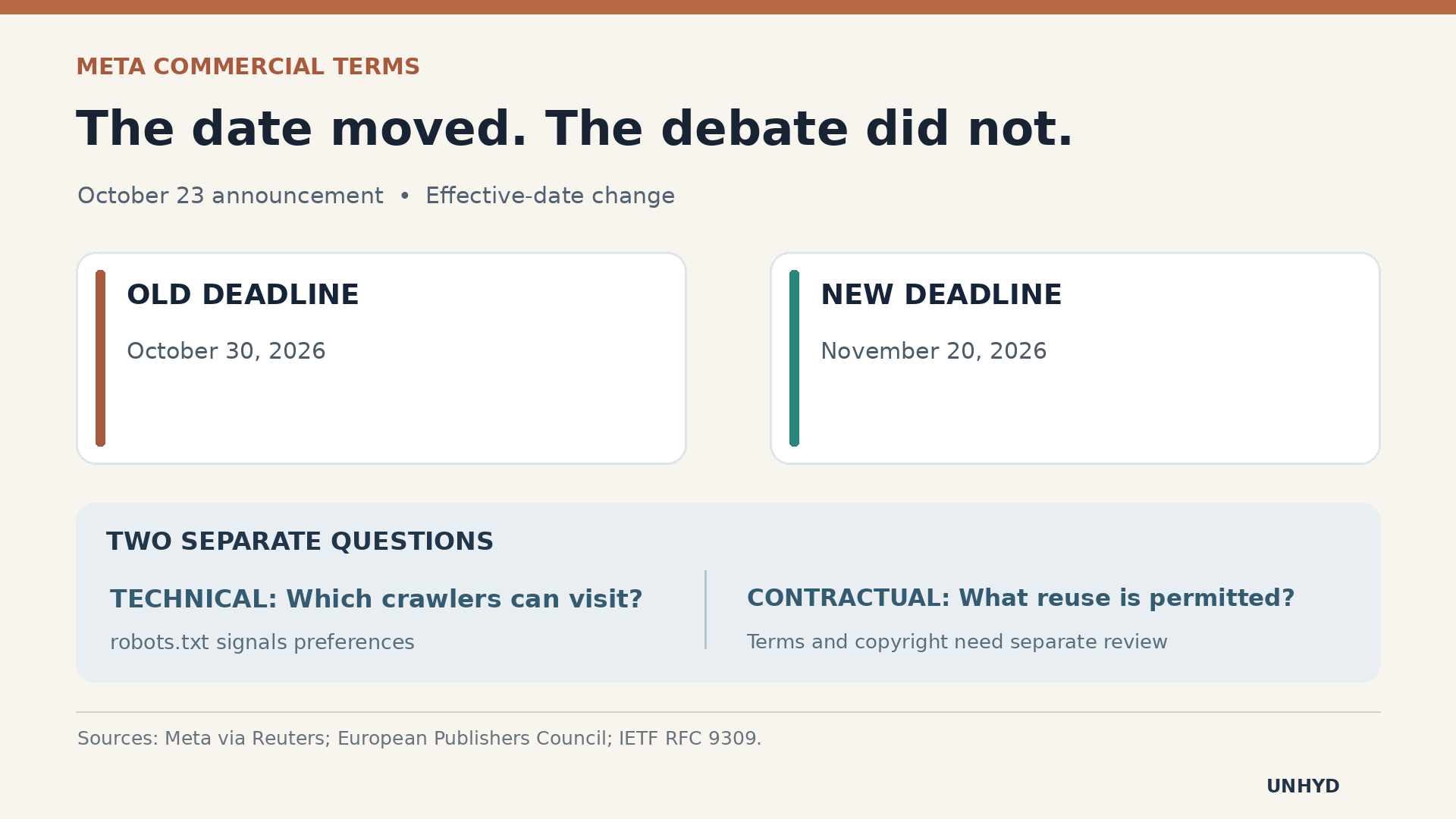
Meta commercial terms that had been scheduled to take effect on October 30 will instead take effect on November 20, 2026, following objections from publishers and advertisers. Meta confirmed the postponement on October 23, saying it needed more time to explain its revised agreements. The extra three weeks change the implementation calendar, but they do not by themselves resolve the dispute over automated access to publishers' websites.
The distinction matters to businesses that depend on Facebook or Instagram to reach customers. Critics argue that the proposed wording could give Meta extensive permission to collect and reuse content from websites connected to business accounts. Meta rejects the interpretation that the terms grant unlimited rights to use publishers' work for AI services.
What changed in the Meta commercial terms
In a statement reported by Reuters on October 23, Meta said the effective date for its Commercial Terms and Self-Serve Ad Terms would move from October 30 to November 20. The company said it would clarify what the revisions do and do not change, including how its web crawlers operate.
That is a postponement, not a withdrawal or a regulatory ruling. Reuters reported that EU and UK authorities had received complaints from publishers and digital advertisers. The European Commission welcomed the delay. There was no reported final finding that the disputed wording violated competition or copyright law.
Because Meta's current legal pages were not accessible without a login during this review, Unhyd has not independently compared every line of the latest live terms with earlier versions. The confirmed new fact is the date change, based on Meta's statement to Reuters and the response of affected publisher organizations.
Why publishers object even after a wording change
The dispute predates the delay. An October 19 Search Engine Journal analysis documented a revision that removed the explicit word “train” from a crawling provision while retaining language allowing automated collection from websites associated with a business's products or services. Meta said the clause related to its advertising and business products, not an expansion of rights over journalism.
The European Publishers Council's latest statement argues that removing a single word does not expressly rule out other uses of collected content, such as grounding or generating summaries. It also objects to language concerning indexing, caching, repeated collection and the creation of test credentials.
Those are the council's legal and commercial concerns, not proven examples of Meta training a model on a particular publisher's articles under the proposed terms. The dispute turns partly on the difference between permission to collect material for a business service and permission to use that material for unrelated purposes.
Robots.txt can express a crawler preference, not settle a contract
Meta says site owners can continue to communicate crawling preferences through robots.txt. That file tells automated visitors which paths a website asks them to avoid. It is a useful operational tool, but it is not a universal technical block and does not decide what contractual rights a company has over content already collected.
The IETF's robots.txt standard, RFC 9309, explicitly distinguishes crawler instructions from access authorization. A site can publish a disallow rule while still needing other measures to protect private content, and a legal agreement may raise separate questions about permitted reuse. The European Publishers Council says technical crawler controls are not a substitute for explicit contractual limits.
For publishers, this creates two different reviews. A technical review asks which automated agents visit the site, which user-agent rules apply and whether server logs show access. A legal review asks what the business terms authorize, which entities can use collected material, whether permissions can be refused and what happens after collection. One review cannot replace the other.
What a publisher or small business can do before November 20
First, identify which Meta business products the organization actually uses, including Pages, advertising tools and other services that may invoke the Commercial Terms. Keep a copy of the applicable terms and note their version and effective date. Because the wording has already changed, compare the current text with the next revision rather than relying on an old screenshot or commentary.
Second, inventory the content and sites associated with those business accounts. A news publisher may promote subscriptions through a Facebook Page while maintaining a much larger archive on its own domain. Whether and how the terms treat that archive is precisely one of the contested questions, so do not assume that a social account automatically transfers copyright or that the contract has no consequences.
Third, review crawler settings and actual access logs with a technical administrator. Check the official crawler documentation and the deployed robots.txt file; avoid copying a blanket block from another website without understanding its effects on link previews, discovery or other useful functions. A robots.txt change cannot retroactively remove content from a dataset, and it should not be described as a guaranteed legal opt-out.
Fourth, if the organization owns valuable journalism, photography or other licensed work, have qualified counsel review the relevant agreement and any third-party rights before the new date. The appropriate response may depend on the publisher's jurisdiction, contracts, business relationships and tolerance for limiting Meta services. Unhyd's earlier analysis of AI and journalism ethics examines why transparency and human accountability matter when technology companies and newsrooms use content in new ways.
What the delay does not establish
The postponement does not mean regulators have found Meta liable, that all publishers are covered identically, or that Meta has admitted using business customers' journalism to train AI. Meta denies the broad interpretation advanced by its critics. Conversely, moving the effective date does not prove that the contested provisions have been narrowed enough to satisfy those critics.
The European Publishers Council has asked the European Commission to scrutinize the proposed conditions and, if necessary, seek a further postponement. Those requests are advocacy positions; any formal legal outcome would require a separate action by the relevant authority.
For readers, the central development is therefore not simply a new deadline. It is an unresolved question about the boundary between using a platform to distribute work and granting a platform broader rights to collect or reuse that work. November 20 gives affected businesses more time to examine the terms, document their choices and watch for substantive clarification—not a guarantee that the dispute will be settled by then.