

October 2026 consumer sentiment barely moved in the University of Michigan’s final reading, but the apparent stability conceals a split in how Americans assess the economy. The headline index was 48.0, compared with 48.1 in September. Beneath that one-tenth-of-a-point change, the measure of current economic conditions fell while the expectations measure rose. The survey director also reported an 18% decline in the component tracking conditions for buying durable goods.
The university’s final October results, released October 23, offer a useful test of what a headline confidence figure can—and cannot—tell readers about household decisions. They do not show that every consumer feels the same way, that actual purchases have fallen 18%, or that survey expectations will become future inflation.
October 2026 consumer sentiment: three readings, three different movements
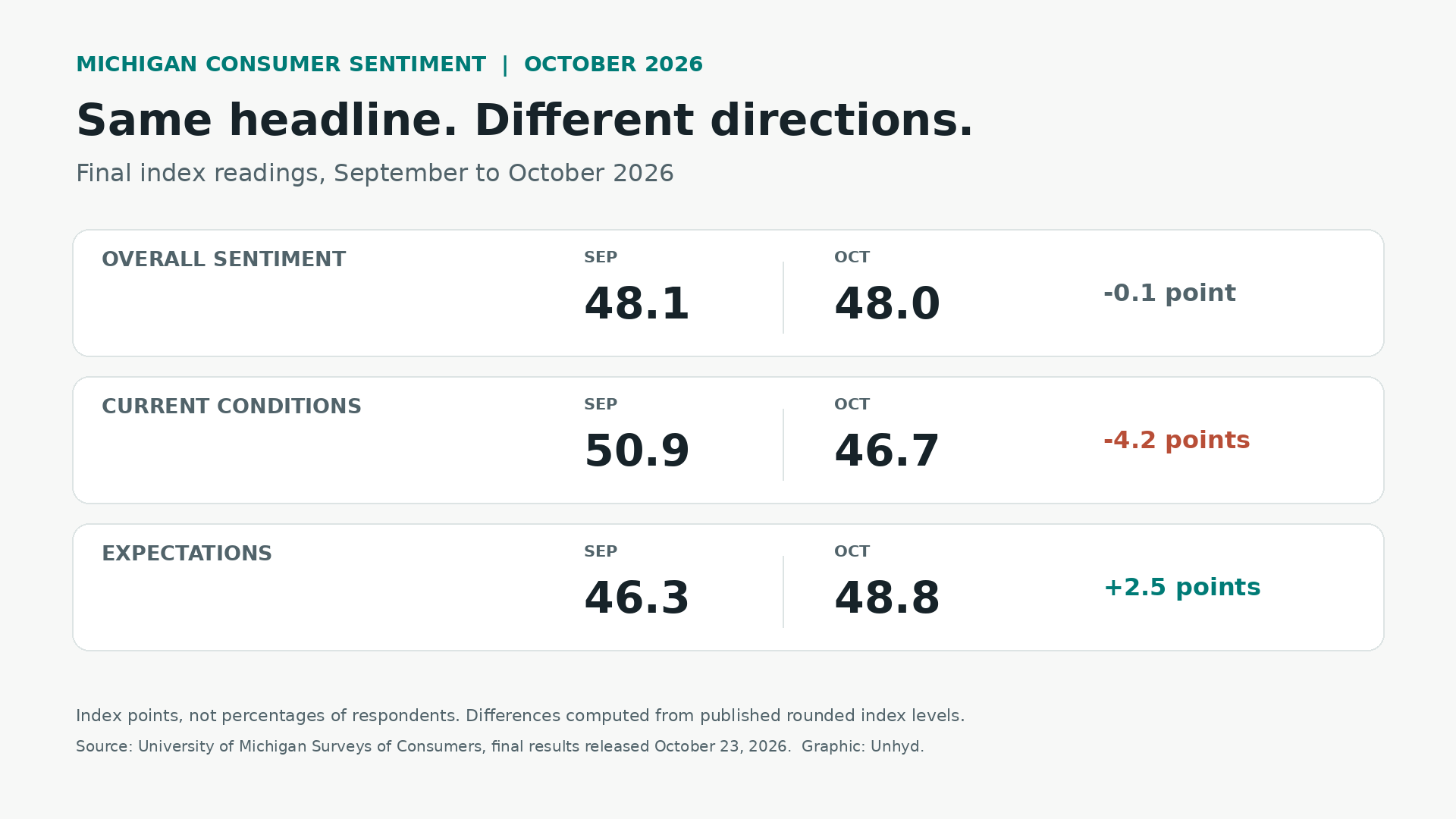
Michigan’s index of consumer sentiment registered 48.0 in October, against 48.1 in September and 53.6 in October 2025. The current economic conditions index was 46.7, down from 50.9 in September. The expectations index rose to 48.8 from 46.3. The figures describe distinct survey measures, not interchangeable percentages of people who are optimistic or pessimistic.
Unhyd calculated the month-to-month differences directly from the published index levels. The headline moved down 0.1 index point; current conditions moved down 4.2 points; expectations moved up 2.5 points. Expressed as changes relative to September’s levels, those are approximately −0.2%, −8.3%, and +5.4%, respectively. The university reports the same rounded relative changes.
That arithmetic explains why “unchanged confidence” is incomplete. The overall reading is a composite measure; its small net movement does not mean all of its components moved together or that conditions are comfortable. It also does not permit a simple average of 46.7 and 48.8 to reproduce the headline. The published indexes have their own construction and weighting.
The buying-conditions signal is more specific than a spending collapse
In her October 23 statement, survey director Joanne Hsu said the decline in the current-conditions index was driven entirely by the component measuring conditions for purchasing durable goods. That component fell 18%, which she linked to high interest rates and growing concern about the affordability of those purchases. The statement describes respondents’ assessments of buying conditions, not a measured 18% fall in appliance, vehicle, or furniture sales.
Durable goods are generally products intended to last for years rather than being consumed quickly. They often require a larger upfront payment or financing. That makes the question of whether now is a good time to buy different from the question of whether a household expects the broader economy to improve next year.
A family might believe business conditions could improve over the coming year while still postponing a replacement car or refrigerator today. That example is an interpretation of how the two survey questions can diverge; it is not a claim that the survey tracked such a family or established its purchasing decision.
The distinction matters to readers comparing news about confidence with reports about actual spending. Survey attitudes can help illuminate pressure points, but retail-sales data, lending terms, and product-specific prices would be needed to establish what households actually bought. A confidence index should not be converted into a sales forecast without additional evidence.
What changed since last year, not just last month
The final October headline was 53.6 a year earlier, making the latest 48.0 reading 5.6 index points lower, or approximately 10.4% below October 2025. The current-conditions index fell from 58.6 to 46.7 over the same period, a decline of 11.9 points, or 20.3%. Expectations slipped from 50.3 to 48.8, down 1.5 points, or about 3.0%.
The longer comparison reinforces the divergence. October’s modest improvement in expectations relative to September did not restore that index to its year-earlier level. And the current-conditions measure was substantially weaker than it was twelve months ago. A positive monthly change is not the same as a recovery to an earlier baseline.
The university’s release also says year-ahead business conditions improved by roughly 14% in October but remained 16% below the October 2025 reading. Those percentages refer to that survey component, not to the national economy’s growth rate. They should not be confused with gross domestic product or an actual forecast of business profits.
Inflation expectations rose even though headline sentiment held steady
Michigan reports that the median expected inflation rate over the next year increased from 4.6% in September to 4.7% in October. The corresponding long-run expectation rose from 3.4% to 3.5%. The university says both measures increased for a second consecutive month and reached their highest levels since May.
These are survey respondents’ expectations, not the government’s measured inflation rate and not a guarantee of future price increases. A 4.7% year-ahead expectation should not be inserted into a household budget as if every bill will rise by exactly that amount. Individual prices and actual inflation can diverge from sentiment.
A separate October 23 research note on long-run inflation expectations places the current readings in historical context and warns about the risk that elevated expectations could become persistent. It discusses historical patterns and methodological consistency, including web-based survey data. That analysis is a warning about possible dynamics, not proof that a self-reinforcing inflation cycle has already taken hold.
The note is also a reminder not to mix unlike series casually. A historical chart based on a particular collection method should not automatically be treated as identical to every headline series or older survey estimate. The sound conclusion is narrower: the latest official release shows higher reported inflation expectations at both horizons while overall sentiment barely changed.
Why this split matters for households—and what it does not establish
For a reader making a major purchase, the survey points to the questions worth separating: the price today, the borrowing rate, the affordability of the monthly payment, and whether waiting is feasible. It does not determine the best decision for an individual family. Someone replacing a broken appliance has a different set of choices from someone considering a discretionary upgrade.
Financing can also change the true price of a purchase. A lower sticker price with expensive borrowing may not be the cheaper total cost. Conversely, delaying a necessary repair can have consequences that a national survey cannot capture. Compare written offers and realistic cash-flow scenarios rather than treating a national index as a personal budget rule.
That separation between a headline number and the cost a household actually faces also appears in health coverage. Unhyd’s analysis of 2027 HSA limits and insurance costs explains why a higher tax-advantaged contribution limit cannot by itself establish whether a health plan is more affordable. The subjects are different, but the analytical principle is the same: do not substitute one broad indicator for the terms of a specific decision.
What to watch in the next release
Michigan lists November 6, 2026, as the date for preliminary November results. A useful follow-up would ask whether the current-conditions measure rebounds, whether the improvement in expectations persists, and whether inflation expectations stabilize. The durable-goods buying-conditions component deserves attention because it drove the latest current-conditions decline, according to the survey director.
Independent Reuters reporting on October 23 corroborates the 48.0 headline and higher inflation expectations. Neither the official release nor that coverage demonstrates that a particular policy caused every change in responses, or that the October survey can predict the election, future interest-rate decisions, or actual retail sales.
The most defensible reading is that October 2026 consumer sentiment remained weak and nearly flat overall while its components pulled in opposite directions. The story is not simply that Americans became more or less confident. It is that their assessment of current buying conditions deteriorated at the same time their outlook for the future improved somewhat—and inflation expectations remained elevated.