

OpenAI models on Google Cloud are moving from a partnership announcement into a limited enterprise rollout. On October 21, 2026, OpenAI and Google Cloud said customers would gain access to OpenAI's frontier models and Codex workflows through Google's Model Garden and marketplace. The immediate qualification is important: the models are entering private preview for selected customers, not becoming universally available today.
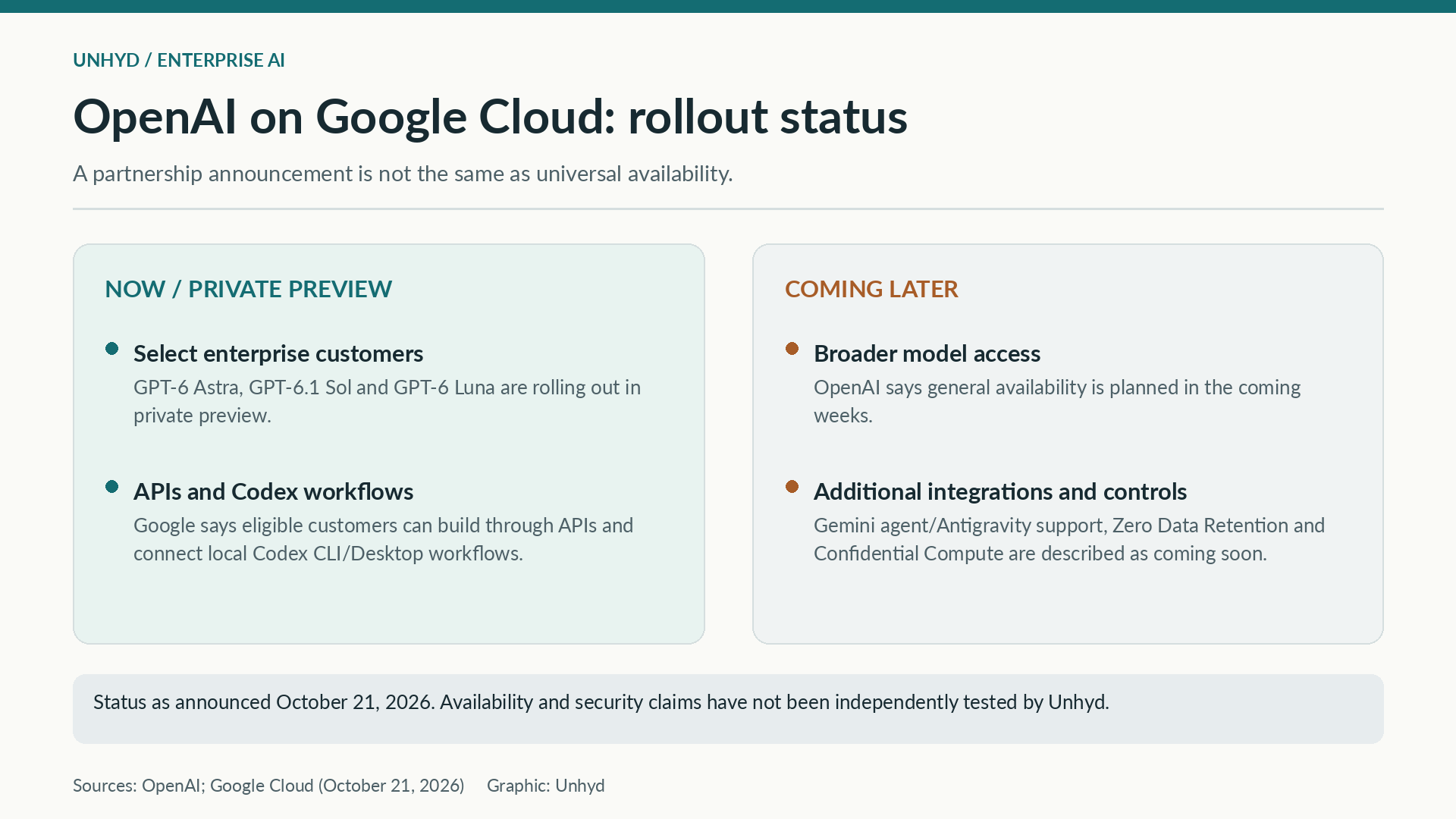
Google identifies GPT-6 Astra, GPT-6.1 Sol and GPT-6 Luna as the first models in the rollout. It also says eligible developers can use APIs and connect local Codex command-line and desktop workflows to Google's platform for inference. OpenAI says general availability is planned in the coming weeks, without giving a firm date.
What the OpenAI–Google Cloud agreement changes
Until now, a business using Google Cloud for data processing, identity management and other infrastructure could still need a separate purchasing or deployment arrangement to use OpenAI's models. The OpenAI announcement and Google Cloud's technical explanation describe a more integrated route: organizations will be able to obtain supported OpenAI models through Google Cloud Marketplace and apply eligible existing Google Cloud spending commitments.
That is a distribution and procurement change, not proof that one model is better than another. Google says model usage will appear on a unified cloud invoice and count toward its Flexible Savings Plans. The companies did not publish a complete, independently comparable price sheet for the new arrangement in their announcements.
Google also says its platform now brings together models from the three leading proprietary-model developers alongside more than 200 other models. That is Google's description of its catalog, not a claim that every model has identical features, access terms or performance.
Private preview is different from general availability
The most useful distinction for an enterprise buyer is between what can be tested now and what remains a future promise. Google says GPT-6 Astra, GPT-6.1 Sol and GPT-6 Luna are rolling out in private preview to selected enterprise customers. Interested organizations are directed to request access. OpenAI says general availability is planned within weeks, but neither announcement supplies a binding date or service-level commitment for that wider release.
Some adjacent integrations are also prospective. The companies describe future availability in Google Antigravity and the Gemini agent. These are not the same as a feature already enabled for every customer. Unhyd previously examined the Gemini agent's enterprise ambitions and governance questions; the new OpenAI arrangement expands the proposed model choices within that broader ecosystem rather than replacing Google's own models.
For teams planning a pilot, the distinction affects budgets, training and deployment calendars. A preview invitation may establish access for a test environment without establishing a production rollout path for an entire organization.
What Google says about security and data handling
Google says prompts, context and outputs for these workloads will remain inside a designated data perimeter and will not be used to train foundation models. It describes isolated infrastructure, authenticated identities, unified audit logging and controls intended to prevent unauthorized access to a customer's cloud environment.
Those statements are vendor claims about the intended service design, not findings from an independent audit conducted by Unhyd. Two features deserve special attention: Google explicitly describes Zero Data Retention options and Confidential Compute as coming soon. A company should not assume those protections are already active merely because they appear in the announcement.
Data location, retention and training use are separate questions. A service might restrict training use while still retaining operational records; a security perimeter might control access without satisfying every industry's legal requirements. Before deploying sensitive workloads, buyers should request the actual service terms, region availability, retention settings, logging details and applicable compliance documentation.
Model choice does not eliminate evaluation work
Google presents the integration as a way to choose among models according to cost, speed and capability. That flexibility may reduce the operational friction of testing alternatives, but it does not mean switching models will preserve output quality or tool behavior automatically.
A defensible comparison uses the same representative tasks, quality criteria, security constraints and complete billed costs. For example, a coding agent that generates an acceptable change in one attempt may cost less overall than a cheaper model that needs several retries. Conversely, an expensive model may be unnecessary for a routine classification task.
Unhyd's analysis of AI API pricing explains why token rates alone are a poor measure of total cost. The same caution applies here: cloud-commitment accounting can simplify purchasing without demonstrating lower cost per completed, accepted task.
Teams should also verify whether tool calls, caching, data transfer, regional processing and other features are billed differently under the new marketplace route. The announcements do not establish a universal savings percentage.
Does this replace Microsoft's OpenAI partnership?
No such conclusion follows from the announcement. OpenAI explicitly says Microsoft remains its primary cloud partner. The Google arrangement adds another enterprise distribution channel; it does not, on its own, establish that OpenAI has moved its principal cloud relationship or changed every existing Microsoft commitment.
That matters because cloud distribution, model hosting, product integration and strategic investment are different commercial relationships. A company can make a model available through multiple marketplaces while maintaining a distinct primary infrastructure partnership.
What enterprise customers should verify next
Before treating the launch as a production-ready alternative, procurement and engineering teams should confirm four things: whether their organization can actually access the desired model; what data and retention terms apply today; how costs and cloud commitments are calculated; and whether the same workflow passes their own quality and security tests.
They should also separate the preview's current capabilities from features described as coming later, particularly Confidential Compute, Zero Data Retention and additional agent integrations. An implementation plan based on announced but unavailable controls may create a compliance gap.
The consequential change is that OpenAI models on Google Cloud are becoming an option inside a major enterprise platform. The unanswered question is how quickly that option will become broadly available, and whether its governance, cost and performance claims hold up in real customer deployments.