
Claude Duet, a new proactive AI agent from Anthropic, entered a U.S. research preview on October 21, 2026. Instead of waiting for each prompt, the assistant is designed to check connected apps, identify work that needs attention and continue tasks on its own cloud-based computer. The important qualifications are that access begins through a waitlist, background work consumes plan limits, and some consequential actions still need explicit human approval.
For people who already use AI to draft documents or answer questions, the shift is from a session-based assistant to a system that can keep a task alive while its owner is elsewhere. Anthropic says the first eligible group is U.S. Pro and Max subscribers, not everyone with a Claude account. Its October 21 product announcement describes the features and their limitations; the company has not published independent real-world reliability results for this research preview.
What Claude Duet can do without a new prompt
Anthropic says Claude Duet draws on memory, skills and connected apps from an existing Claude account. It can produce a morning brief from a calendar and messages, follow up on ongoing work and notify a user when it judges that an item needs attention. It checks connected accounts every few hours rather than continuously. That frequency matters: an item can become urgent between checks, and the system can misjudge its significance.
Tasks can range from drafting responses and scheduling work to assembling a research brief, financial forecast or dashboard. The assistant has its own virtual machine and browser, so the user's laptop does not have to stay switched on. These are capabilities Anthropic describes, not evidence that every workflow succeeds reliably or that every connector exposes the same functions.
Anthropic says the agent can use its connector and plugin ecosystem for activities involving email, customer-management systems, accounting and business tools. For a small business, that might mean finding an unpaid invoice and preparing a reminder. It does not mean the assistant should automatically be trusted to send that reminder or move money without review.
Who can get Claude Duet now?
Claude Duet is available through a research-preview waitlist for Pro and Max subscribers in the United States. Anthropic describes separate Duet experiences on iOS, Android and the web. A subscription does not itself guarantee an immediate invitation, and the company has not provided a firm date for wider access or Team and Enterprise availability in its launch announcement.
Duet is powered by Claude Opus 5.5, according to Anthropic. It carries over existing Claude context, but the company says Duet currently lives in a separate app. Users should not assume the experience or access terms are identical to the regular Claude interface.
Which actions need permission?
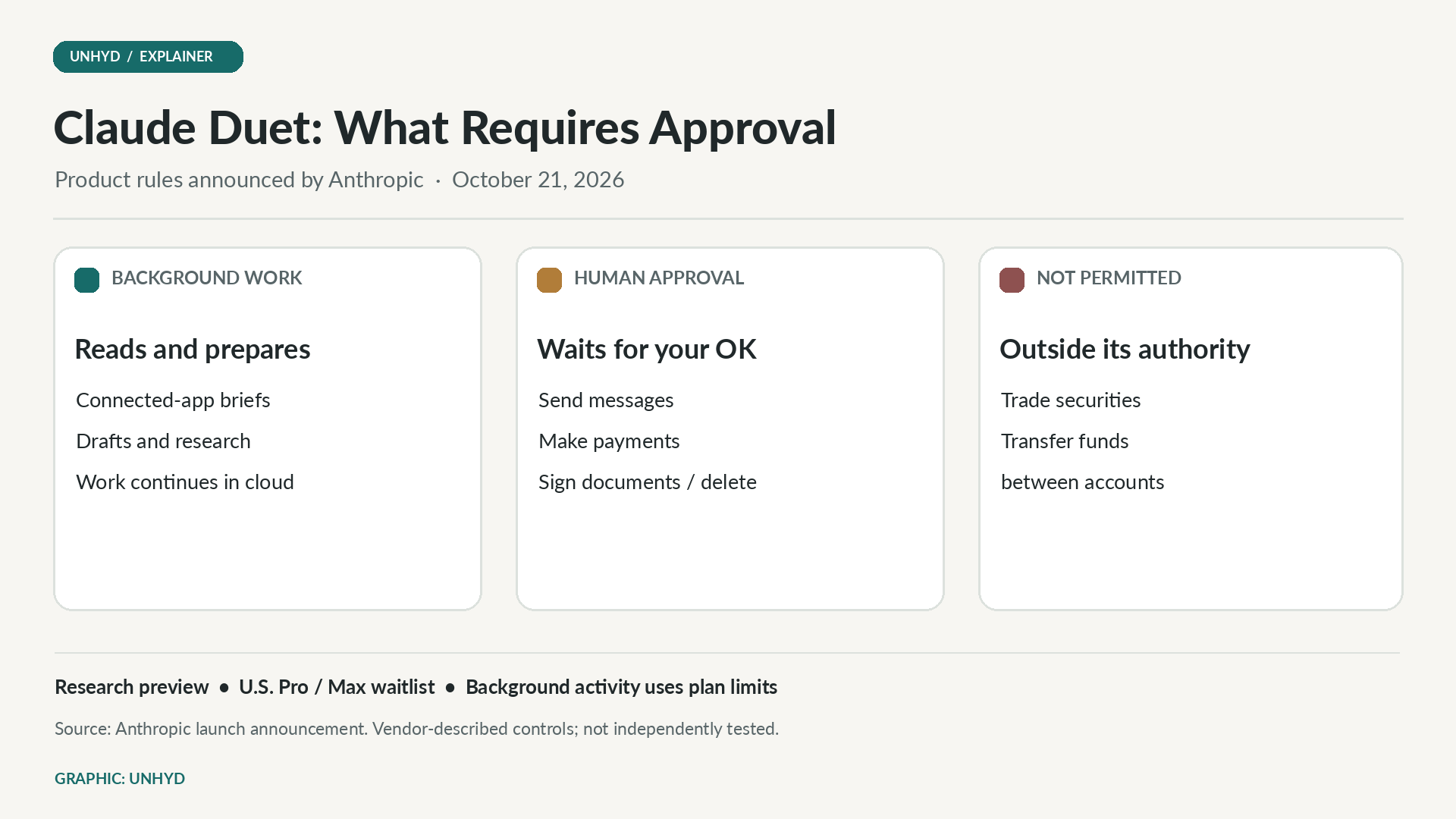
The clearest dividing line in Anthropic's description is between preparing work and taking consequential action. Claude Duet can read information and draft material, but it is designed to stop and show the user what it proposes before sending a message, making a payment, signing a document or deleting something. Anthropic says securities trading and transfers between accounts remain off-limits even if a user approves them.
That boundary is more useful than a generic promise of safe automation, but it remains a vendor-described control. Users need to check whether an approval identifies the exact recipient, amount, document or deletion target and whether an unexpected instruction from an email or webpage could influence the proposed action.
Unhyd's permission-first AI agent security guide explains why tool access, approvals and logs should be scoped to the task rather than inherited broadly from a user's account. For a product that may read private correspondence and prepare external actions, those are operating requirements, not optional technical details.
Why background work affects usage limits
Anthropic says Duet is included with eligible Pro and Max plans during the preview, but it shares their existing usage limits. Checking accounts in the background counts toward those limits, and a complex project may require many model turns. A user could therefore reach a limit sooner than when using Claude only for occasional chats.
This is a meaningful cost-of-use distinction even when the subscription price does not change. The right question is not only how many tasks Duet can start, but how many it completes correctly before the account's allowance is exhausted. The launch announcement does not supply a standardized comparison of tasks completed per plan.
What about privacy and security?
Anthropic says the assistant's credential-handling design prevents the model from directly seeing passwords or sign-in tokens. It also describes classifiers and safety rules intended to block disclosure of highly sensitive information such as payment-card numbers and government identifiers. The company says other sensitive information, including health or personal-finance details, should be sent only when explicitly instructed by the user.
These protections are claims about the product's design. Anthropic reports adversarial testing and outside penetration testing, but it has not released a complete public assessment establishing that every connected workflow is secure. The company also acknowledges that the preview may misread a thread or misjudge urgency, and that users cannot yet watch its browser work live.
Readers who want to compare the broader product category can consult Unhyd's earlier coverage of OpenAI's always-on Dots agents. Both announcements involve continuing tasks and connected apps, but different vendors' approval, memory and availability terms should be assessed separately rather than treated as equivalent.
How to test an always-on agent before trusting it
Start with a reversible task, such as summarizing a non-sensitive inbox folder or preparing a meeting brief. Compare the output with the original records. Then check what permissions the assistant requested, how it reports uncertainty, whether its notifications are useful and how easy it is to disconnect a service.
For tasks involving customers, payments or confidential files, test approval behavior with realistic edge cases before expanding access. Keep a human accountable for external communications and financial decisions. An assistant that does not need a fresh prompt can save attention, but it can also create work that is harder to notice until something goes wrong.
Claude Duet's consequential new feature is continuity: it is intended to notice, prepare and continue work without constant prompting. Its actual value will depend on whether invited users can verify the work, contain the permissions and predict the cost of background activity—not merely on how proactive the interface feels.