The FAA ground stop that halted departures across the United States on Friday, November 13, has ended, but its effects did not disappear when the airspace reopened. The Federal Aviation Administration said communication problems affected multiple air route traffic control centers. Transportation Secretary Sean Duffy said the nationwide restriction was lifted at 8:15 p.m. Eastern, while warning that aircraft, crews and flight schedules would need time to recover.
For travelers checking flights on Saturday, November 14, the important distinction is between permission to depart and an airline's ability to operate a particular flight. A reopened airspace system does not guarantee that a delayed aircraft is at the right airport, that its crew remains available or that a connecting itinerary still works. The immediate cause is also not the same as a completed investigation into every contributing factor.
What caused the FAA ground stop?
In its November 13 statement, the FAA described communications issues affecting multiple Air Route Traffic Control Centers and characterized its information as preliminary. The Transportation Department's subsequent briefing described intermittent telecommunications outages that destabilized communications and radar information used by air traffic control.
Duffy said older switches and routers became overloaded and produced inconsistent data. He said the system had not lost all radar or telecommunications capability, but the instability justified stopping departures as a precaution. That is the administration's initial technical explanation, not a published independent root-cause report identifying every failed component or proving that modernization work would have prevented the incident.
November 14 update: At a Saturday briefing, Transportation Secretary Sean Duffy said investigators were examining work by contractor L3Harris to migrate a remote telecommunications connection from copper to fiber. He described more than 1,000 connection attempts every four to five seconds that disrupted communications and radar feeds. Officials had not determined whether an installation error or faulty router was responsible; those possibilities must not be presented as a final root-cause finding. The department said U.S. airspace was open but travelers should still expect some cancellations and delays. Read the November 14 DOT briefing.
In a November 14 statement, L3Harris said it was supporting the FAA investigation and had completed more than 70% of the planned conversion of airspace communications from legacy copper lines to fiber. That progress figure is the contractor’s own account; its statement did not establish the root cause of Friday’s failure.
November 15 update: In a newly published explanation, the FAA said a telecommunications network became unstable when approximately 1,000 connection attempts were generated every four to five seconds. The agency reported instability at 17 of its 22 Air Route Traffic Control Centers, although some communications frequencies and radar feeds remained operational. Officials said they disabled the originating router functionality and, as a precaution, the same functionality on approximately 60 similar routers. The FAA reported no indication of a cyberattack and said its investigation into the L3Harris-operated network was continuing. The agency also reported approximately 12,462 Friday flight cancellations, while cautioning that not all were directly caused by the nationwide ground stop.
The secretary also said the FAA's newer SMART air-traffic forecasting tool was disconnected from the affected systems and did not cause the disruption. Officials reported no indication of malicious activity at the time of their statements. Neither point should be stretched into a broader claim that every possible cause has been conclusively ruled out.
Why flights can remain disrupted after the ground stop ends
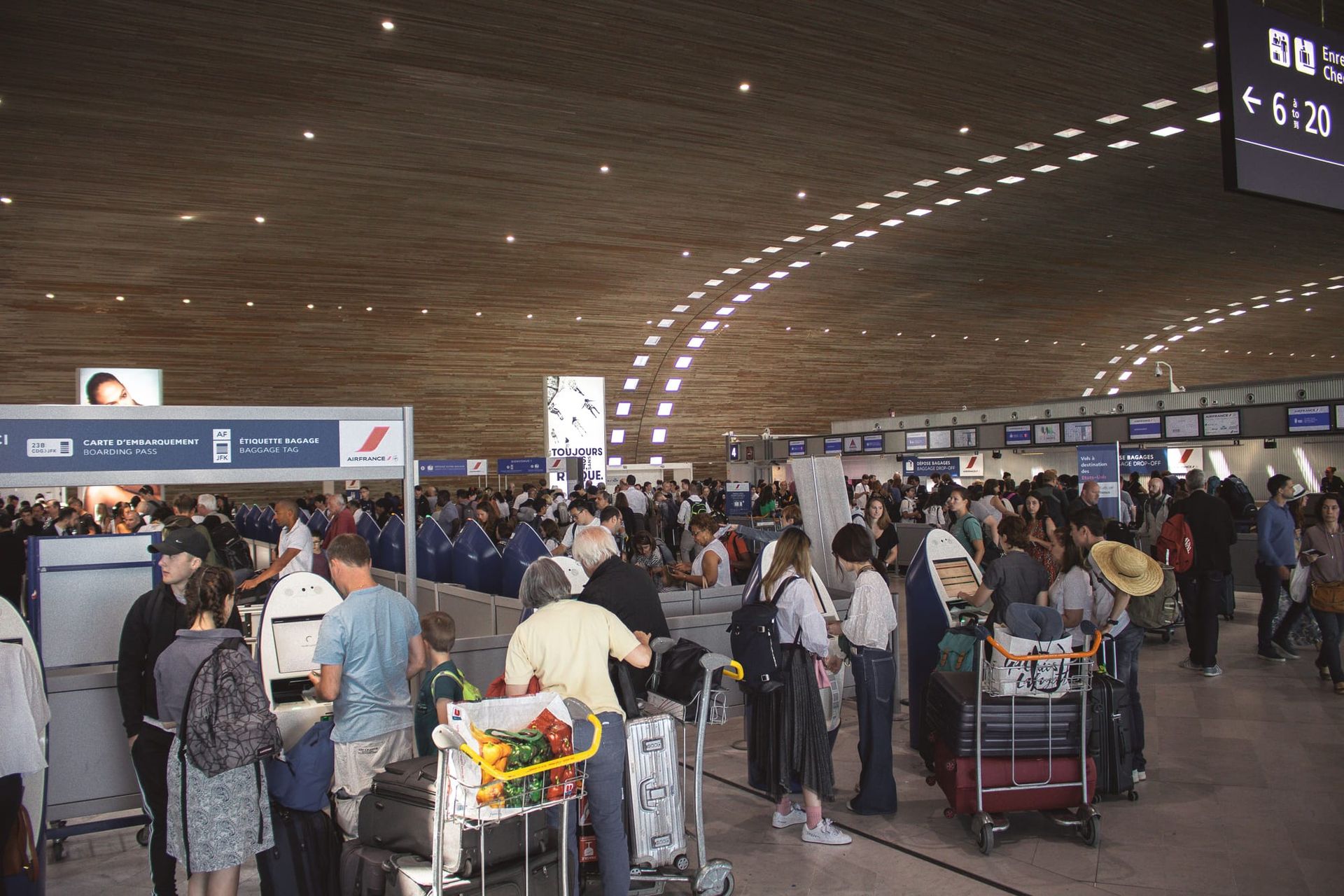
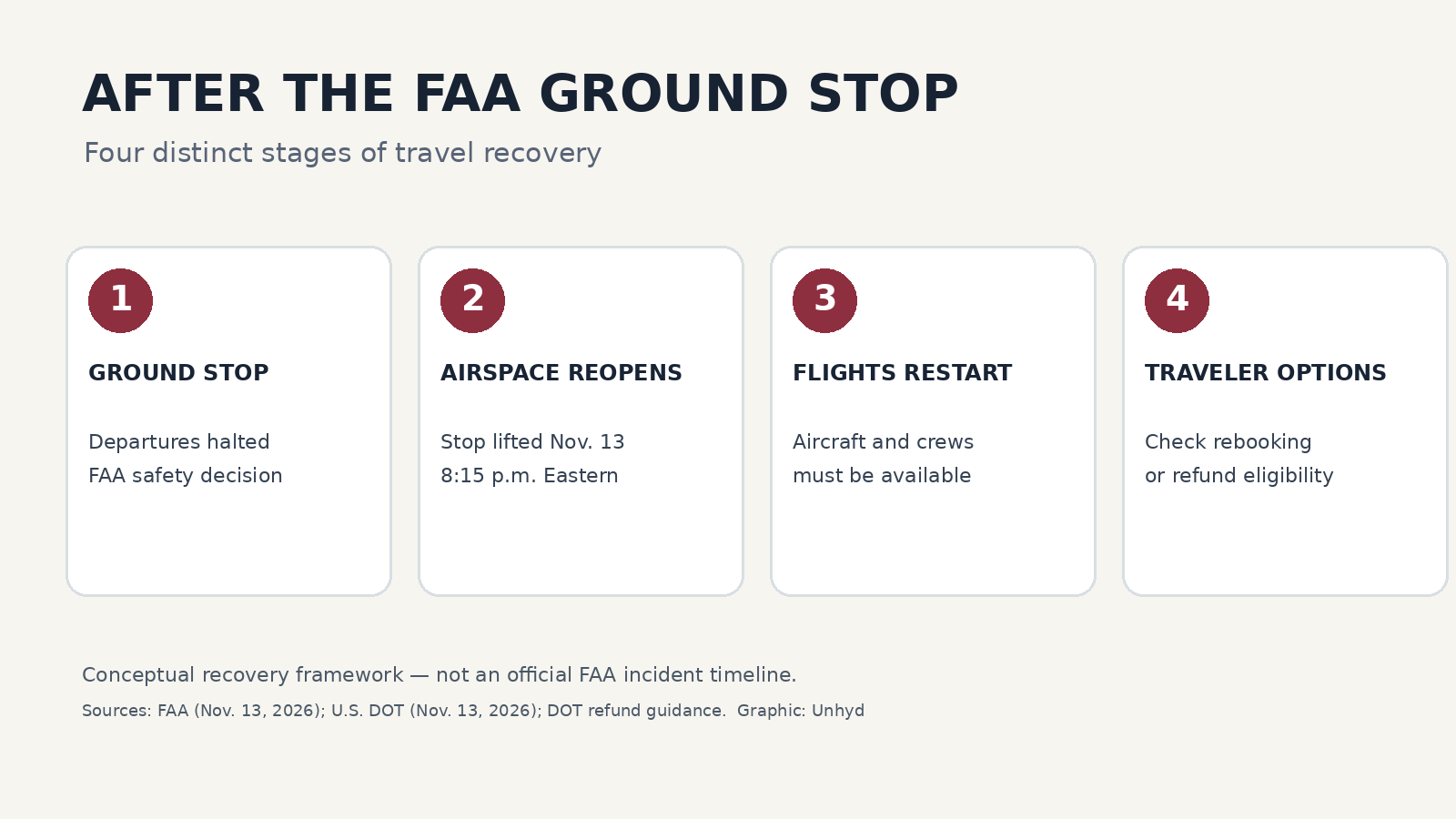
The nationwide restriction was lifted on Friday evening, but the Transportation Department cautioned that flight operations would restart gradually. During a prolonged stop, planes can finish journeys at different times from those originally planned, connecting passengers can miss departures, and crews may no longer be positioned to operate their next assignments.
Those effects can continue even after the original technical failure is addressed. An airline may need to move an aircraft to its next departure airport, arrange an available crew or rebuild a sequence of connecting flights. The reopening time is therefore a verified national milestone, not a promise that a particular Saturday flight will depart on schedule.
Saturday recovery outlook: FAA Administrator Bryan Bedford said the national flight schedule should return toward normal by Sunday evening, November 15, while cautioning that cancellations and delays would continue Saturday. That is an official forecast, not a guarantee about any individual itinerary. Associated Press reported more than 6,000 Saturday cancellations as of its reporting; the total is time-dependent and should not be treated as a final count.
Independent reporting by Reuters and Associated Press describes widespread cancellations and disruption after the stop. Counts differ by reporting time and by whether they include cancellations, delays or both. This article does not present a single national tally as a final verified count.
What travelers should check before leaving for the airport
First, check the operating airline's app or website for the specific flight number, not only the airport's general status. If the itinerary includes a connection, verify each segment and allow for the possibility that a rebooked first flight will not preserve the original connection. A notification that the nationwide stop ended is not confirmation that an individual itinerary is intact.
Second, preserve the original confirmation, the airline's cancellation or delay notices, and any alternative itinerary offered. If the airline proposes a different airport, additional connection or substantially later arrival, compare the new itinerary against your original booking before accepting. Keep receipts for necessary expenses, but do not assume every expense is automatically reimbursable.
FAA ground stop refunds: what federal rules actually cover
The U.S. Department of Transportation's refund guidance says a passenger is entitled to a ticket refund when an airline cancels a flight and the passenger chooses not to travel or accept an alternative. Refund eligibility does not depend on the airline being responsible for the cause of the cancellation. A significantly changed or delayed itinerary can also qualify when the passenger declines the changed travel arrangements.
Under DOT's published definitions, a significant change can include an arrival at least three hours later for a domestic itinerary or six hours later for an international itinerary, as well as certain airport, connection or cabin changes. The precise entitlement depends on the ticket and what the traveler accepts. A passenger who chooses to take the replacement flight generally does not also receive a full refund of the fare under these rules.
The rules distinguish a refund for transportation not taken from compensation for inconvenience, meals or a hotel. An FAA infrastructure failure is not automatically an airline-controlled disruption. Travelers should check the carrier's current customer-service commitments, their travel insurance terms and any specific waiver, rather than assuming that a cancellation guarantees reimbursement for accommodation or other incidental costs.
When a refund is due, DOT generally requires prompt return to the original payment method: seven business days for credit-card purchases and 20 calendar days for other payment methods, subject to the rules' triggering conditions. Airlines must inform eligible customers of their refund rights. Travelers should not accept a voucher without understanding whether they are giving up a cash refund to which they are entitled.
What the outage reveals about the air traffic system
The Transportation Department linked Friday's disruption to aging communications equipment and renewed its case for a broader air-traffic-control modernization program. That policy argument is consequential, but it remains separate from the technical investigation. The fact that officials identified older equipment does not by itself establish which procurement decisions, maintenance practices or individual changes caused the nationwide failure.
There is a useful distinction between the system that manages aircraft movements and the airlines that manage passengers, crews and reservations. The FAA can restore a national operating capability while individual carriers still face recovery work. A similar distinction appears in Unhyd's coverage of the Microsoft 365 outage, where restored service access did not automatically resolve interrupted business tasks. Readers should be skeptical of explanations that collapse those responsibilities into a single statement that the system is either fully down or fully fixed.
What remains unanswered after the FAA's November 15 update
The FAA’s initial statement was preliminary. Although officials have identified a network overload during modernization work and the contractor has responded, the final root cause, complete technical timeline and fully reconciled disruption totals were not established as of this November 14 update. Further FAA advisories, carrier updates and any subsequent investigation may change the picture.
For now, travelers can make two decisions with greater confidence: verify their actual flight before traveling to the airport, and evaluate any cancellation or significant change against the DOT's published refund rules before accepting a replacement itinerary. Friday's ground stop has ended; the recovery of every disrupted journey is a separate question.