

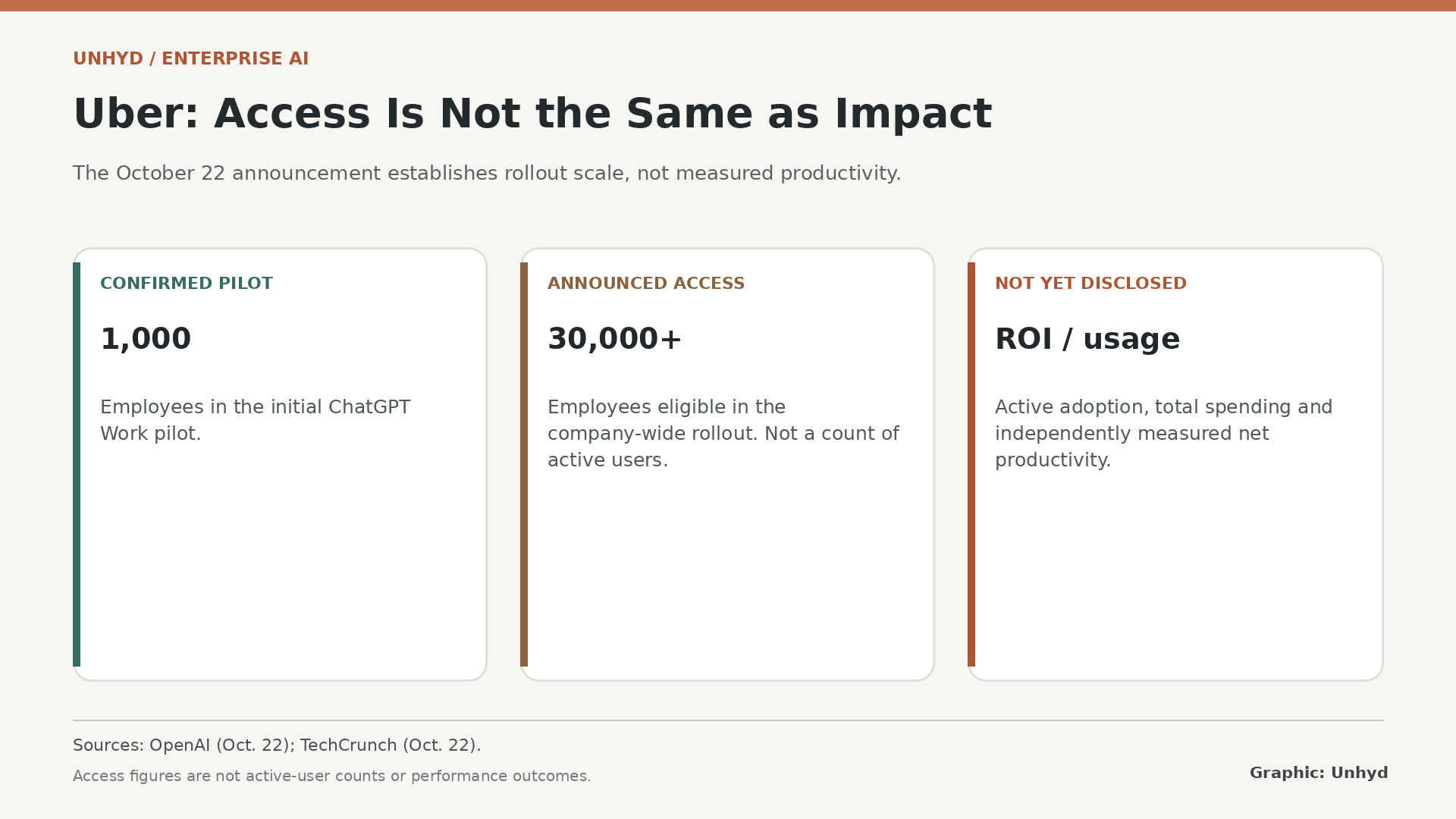
The Uber ChatGPT Work rollout is moving from a limited experiment to company-wide availability. On October 22, 2026, Uber and OpenAI announced that more than 30,000 employees would gain access to ChatGPT Work, an AI agent designed to complete multi-step office tasks across connected applications. The expansion follows a pilot involving 1,000 employees.
The scale is consequential, but the distinction between access and results is easy to miss. A company can give tens of thousands of people a tool without establishing how many use it regularly, whether it improves accepted work or whether the benefits exceed its full operating costs. Uber and OpenAI have not yet published those measures for the new rollout.
What the Uber ChatGPT Work rollout actually includes
In OpenAI's October 22 announcement, the companies say the agent will be available to Uber employees across operations, finance, marketing, product and other functions. It can connect to Google Drive, Gmail, Google Calendar and Slack, enabling workflows such as preparing meeting briefs, analyzing information and creating presentations.
The company also plans to use an internal AI skills library, approved integrations and dedicated training. OpenAI says GPT-6.1 Sol will be the default model in ChatGPT Work at Uber, while engineering teams will continue using Codex for software development. Those are deployment plans and product capabilities, not evidence that every employee has already completed a successful agent-run workflow.
OpenAI describes the deployment as Uber's first company-wide agentic platform for knowledge work. The companies say they will share additional adoption and outcome information later, leaving important questions unanswered at launch.
The pilot shows breadth of use, not a company-wide success rate
The pilot began with 1,000 employees. In reporting published October 22, TechCrunch quoted Uber engineering vice president Sumanth Sukumar describing pilot tasks that included analyzing operations data, localizing training material and building interactive dashboards. He said about 80% of early adopters were non-engineers.
That detail matters because it suggests interest beyond software developers, but it does not mean 80% of all Uber staff used the product or that 80% of pilot participants achieved a defined productivity gain. The report does not provide a controlled comparison of task quality, hours saved, error rates or employee satisfaction.
Uber also described pairing 30 AI engineers with other teams for two weeks to automate parts of their jobs. This is an example of hands-on support for experimentation, not an independently verified company-wide return-on-investment result. A pilot can help identify promising workflows without settling whether those workflows will work equally well across departments and countries.
Access, adoption and productivity are three different measurements
First is access: the number of employees permitted to use the tool. The announcement establishes a rollout to more than 30,000 workers. Second is adoption: the number who actually use it, how frequently and for which tasks. Third is impact: whether accepted work improves after accounting for review, corrections, training, subscriptions and integration costs.
These measurements can move independently. A team might have high adoption but little net time saving if employees spend hours correcting outputs. Another team might use an agent less often but save substantial effort on a narrow, repetitive task. A company-wide license count cannot distinguish between those outcomes.
A useful evaluation would compare representative workflows before and after deployment, record time to an accepted result, track error and rework rates, and account for the cost of human oversight. It would also examine whether improvements persist once the initial novelty and intensive pilot support fade.
Why security and permissions become more important at this scale
Connecting an agent to mail, calendars, files and workplace messages gives it context that an isolated chatbot lacks. It also creates a need to define what the agent may read, draft, change or send. The public announcement references approved integrations and training but does not publish Uber's detailed permission configurations, incident data or audit results.
For example, the authority to summarize an internal document should not automatically include permission to send its contents to an external recipient. An agent that drafts a report should not necessarily be able to change the underlying business records. Unhyd's permission-first guide to AI agents explains why narrowly scoped access and human approval remain central to workplace deployment.
These are governance questions for any large enterprise, not allegations of a security failure at Uber. The absence of public detail about a configuration should not be interpreted as evidence that the company lacks controls.
What Uber has not disclosed
The October 22 materials do not establish the contract's total cost, the share of employees who will become active users, the number of tasks completed successfully or a measured productivity improvement attributable to ChatGPT Work. TechCrunch reported that Uber did not disclose its spending and plans to evaluate usage and workflow outcomes as the deployment progresses.
Those gaps matter because the workplace AI debate often moves directly from the size of a rollout to assumptions about jobs and efficiency. Unhyd has previously covered research examining how AI changes work inside organizations. Its central distinction is relevant here: tool availability is a management decision, while actual effects on workers depend on job design, oversight and the evidence collected afterward.
Nothing in this rollout announcement demonstrates that ChatGPT Work caused a specific staffing change at Uber. Nor does it establish that every task completed by an agent replaces human work rather than supporting it.
What would make the next update genuinely informative?
The strongest follow-up would report the share of eligible employees who used ChatGPT Work over a defined period, the types of workflows that remained in use, the quality of completed tasks and the time saved after review. A credible business case would also show costs and explain how results were measured against a baseline. Unhyd's AI-agent evaluation framework provides a practical set of outcome, safety and review measures for such a comparison.
Uber's decision to make an AI agent available across its workforce is a substantial distribution milestone. Whether it becomes a productivity milestone is still an open question. The next meaningful evidence will be what employees actually do with the system—and what those workflows demonstrably improve.