
CrowdStrike and Zscaler have agreed to a $43.9 billion all-stock acquisition, a proposed combination that would bring CrowdStrike's endpoint-security business together with Zscaler's cloud-delivered network access controls. The CrowdStrike Zscaler acquisition, announced November 23, 2026, is not completed: it requires shareholder and regulatory approvals, and the companies say they will operate independently until closing.
The central question for enterprise customers is not simply whether a larger cybersecurity vendor can sell more products. It is whether joining endpoint signals, network traffic inspection and access policy can improve security outcomes without sacrificing interoperability, clear accountability or pricing flexibility.
What the $43.9 billion agreement actually commits to
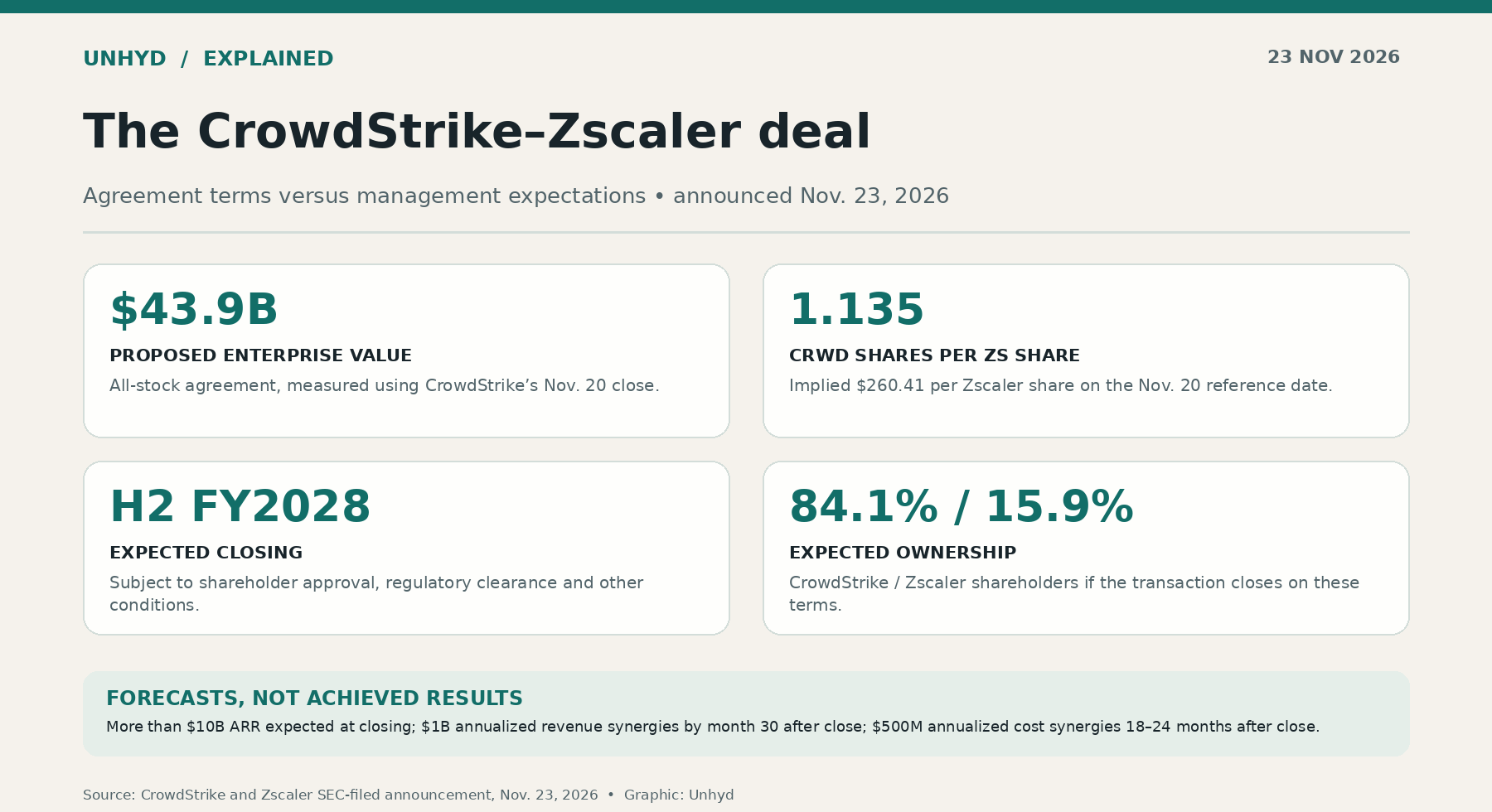
The companies' SEC-filed transaction announcement describes an enterprise value of approximately $43.9 billion, calculated using CrowdStrike's November 20 closing share price. Each Zscaler share would be exchanged for 1.135 CrowdStrike shares, implying about $260.41 per Zscaler share on that reference date—a roughly 34% premium to Zscaler's then-closing price. Because consideration is paid in stock, the market value of that exchange can change before closing.
Both boards unanimously approved the agreement. If completed on the announced terms, existing CrowdStrike stockholders are expected to own about 84.1% of the combined company and Zscaler stockholders about 15.9%. The target closing period is the second half of CrowdStrike's fiscal 2028, conditioned on Zscaler stockholder approval, regulatory clearance and other customary requirements. Zscaler founder Jay Chaudhry and affiliates holding approximately 34% of its shares have entered voting agreements supporting the transaction.
Chaudhry is expected to continue leading the Zscaler business and join CrowdStrike's board after closing. That is a planned leadership arrangement, not a present-day change in ownership or governance.
Why endpoint and network security are complementary—not identical
CrowdStrike's Falcon platform is built around telemetry and response for endpoints, workloads and related enterprise risks. Zscaler's Zero Trust Exchange concentrates on connecting users, devices and applications through cloud-delivered access and security controls. The two approaches observe different parts of an organization's exposure: a device may be healthy while a session accesses the wrong resource, or access rules may be sound while malicious activity runs on an endpoint.
Connecting those signals could make it easier for defenders to use device posture when granting access and to investigate suspicious connections alongside endpoint behavior. But those are potential benefits, not test results. A vendor must show how quickly detections propagate across systems, how conflicting rules are resolved, and whether customers can examine the evidence behind an automated decision.
Unhyd's existing zero-trust security explainer describes why each access request needs appropriate verification. The acquisition does not change that principle: a consolidated vendor is not a substitute for least privilege, independent testing and good identity governance.
A longstanding partnership is not yet a unified product
The companies say they already have more than 2,000 shared customers and 16 integrations. Those figures are relevant because some organizations have experience operating both technologies. However, a preexisting integration is different from one engineering roadmap, shared telemetry model, unified contractual terms or an integrated support organization.
CrowdStrike describes a future single platform, single data layer and single contract. Those outcomes depend on closing the acquisition and delivering subsequent integration work. Buyers should ask which features would still be separate products, how existing policies and APIs will be maintained, and whether integrations with competing tools remain supported. A simpler buying experience can be valuable; it can also create new concentration risks when several critical controls depend on one supplier.
Which financial benefits are forecasts, not results?
CrowdStrike expects the combined business to begin with more than $10 billion in annual recurring revenue at closing. It also projects approximately $1 billion in annualized revenue synergies by the end of the first 30 months following closing, plus approximately $500 million in annualized cost synergies within 18 to 24 months after closing. Its estimate of more than $185 billion in additional addressable market by calendar 2029 is a market opportunity claim—not signed contracts or revenue already earned.
None of these forecasts establishes what customers will pay, whether product performance will improve, or which expected efficiencies will materialize. Reuters reported that investor reactions diverged on announcement day, with attention to the share-exchange valuation and possible antitrust scrutiny. A market reaction is useful context, but it is not proof of the deal's long-term value.
Five questions security teams should ask before changing their plans
- Where is the evidence of improvement? Request controlled comparisons for detection, access enforcement and incident response, specifying baseline products, test conditions and failure cases.
- What changes before closing? The companies say they remain independent. Customers should not assume a new entitlement, service-level agreement or shared data environment already exists.
- Will third-party connections survive? Ask for commitments concerning open APIs, log exports, identity providers, competing endpoint tools and cloud platforms.
- How will pricing and support work? Distinguish existing contracts from future bundled offers, and document migration, data-retention and exit requirements.
- What happens if the merger is delayed or blocked? Maintain a workable security plan using capabilities available under current agreements, not promised consolidation.
These questions also matter as companies deploy AI agents capable of making requests across business systems. Unhyd's permission-first guide to AI agent security explains why authorizations and auditability must be assessed independently of a platform's marketing claims.
What comes next
The proposed deal creates an unusually consequential test of cybersecurity consolidation: bringing device protection and network access together might reduce operational friction, while also raising concerns about competition, switching costs and centralized control. The next verifiable checkpoints are the transaction's formal registration and proxy materials, Zscaler's shareholder vote, regulatory review and any specific product-integration milestones the companies disclose.
Until those events occur, the accurate distinction is simple: CrowdStrike and Zscaler have announced a binding acquisition agreement, not a completed merger or a demonstrated security breakthrough. Enterprise buyers can evaluate the strategic promise now, but should base procurement decisions on products and protections that exist today.