

Can you catch up on sleep after a week of late nights? Sleep debt can sometimes be partly offset by extra rest, but it is not reliably erased by one long weekend or a substitute for getting enough sleep regularly. That distinction matters because the research is more nuanced than either popular extreme: that every lost hour can be repaid like a bill, or that sleeping longer after a difficult week is pointless.
A 2026 study following more than 85,000 adults found that people who showed a rebound in sleep after periods of restriction did not have the same observed mortality association as those who stayed severely short on sleep. Earlier laboratory research found that a weekend of recovery sleep did not prevent metabolic disruptions when people repeatedly returned to five-hour nights. The findings are not necessarily contradictory. They ask different questions, measure different outcomes and have different limitations.
What is sleep debt?
Sleep debt is a way to describe the gap between the sleep a person needs and the sleep they obtain over time. If someone needs eight hours and gets six on each of five nights, a simple calculation produces a ten-hour shortfall. That arithmetic is useful for recognizing a pattern, but it is not a clinical measurement of how many hours must be slept back.
The body does not operate like a checking account. Sleep pressure, circadian timing, sleep quality and the depth of recovery all matter. A person who sleeps ten hours on Saturday may feel more alert without having reversed every cognitive or metabolic consequence of a week of insufficient sleep.
For most adults, public-health guidance recommends at least seven hours, with individual needs varying. The National Institutes of Health emphasizes both adequate duration and healthy sleep habits, and cautions that weekend sleep-ins may not replace all the sleep missed during the week.
Can you catch up on sleep on weekends? What the studies actually found
The strongest answer is that some recovery is plausible, but the extent depends on what you mean by recovery. Feeling less sleepy tomorrow, restoring performance after one bad night, improving blood-sugar regulation and changing long-term health risk are four different outcomes. A study that answers one cannot settle all four.
The 2019 experiment: two recovery nights did not undo repeated restriction
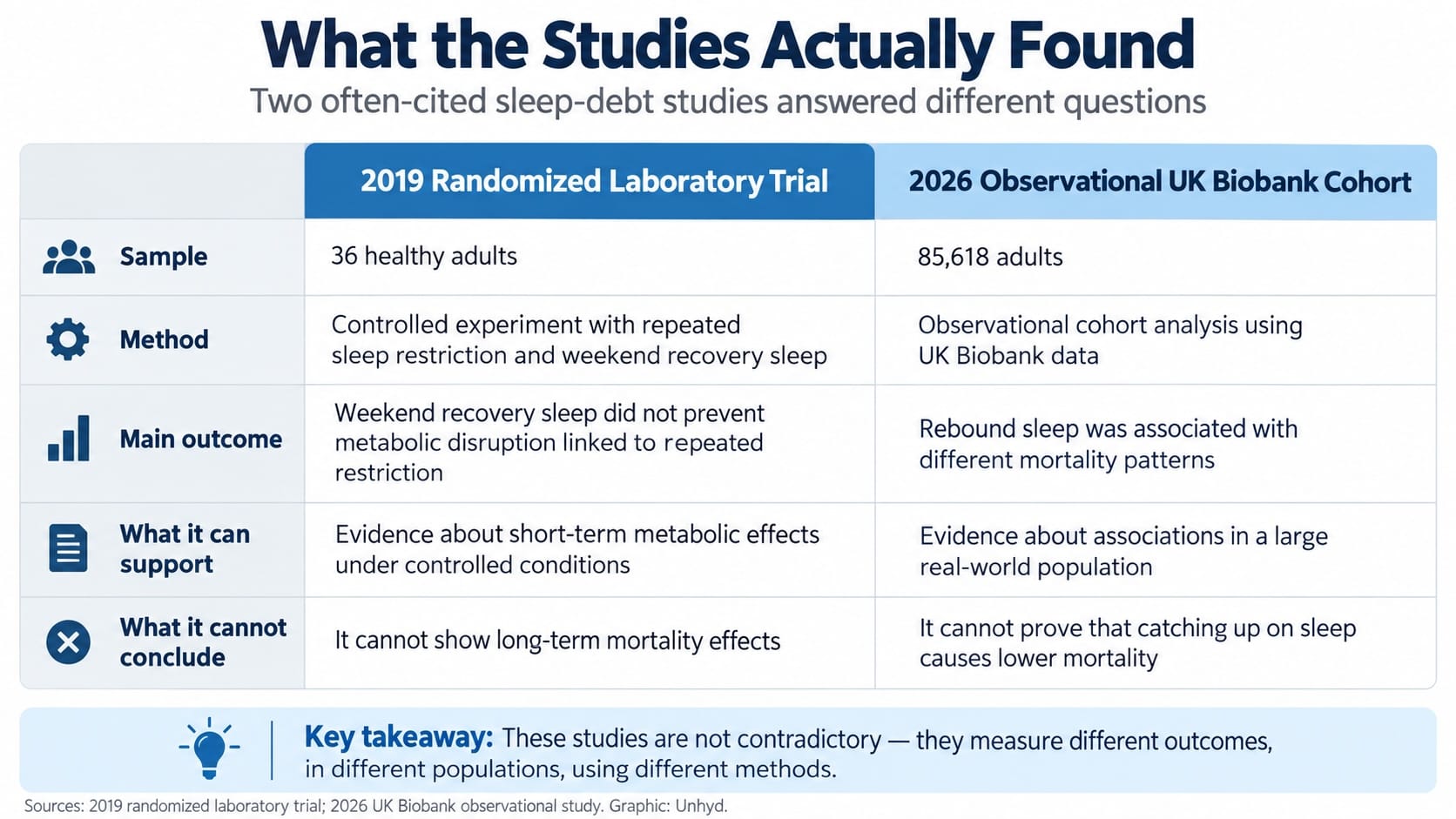
In a 2019 controlled experiment funded in part by the National Institutes of Health, researchers studied 36 healthy adults in a sleep laboratory. One group had generous sleep opportunities, another was limited to five hours a night, and a third had five restricted nights followed by two nights of unrestricted recovery and then another two restricted nights.
Both restricted groups showed changes in eating behavior and insulin sensitivity. The weekend-recovery group did not escape those effects when short nights resumed. The study provides experimental evidence against using two weekend nights as a metabolic fix for a repeated pattern of serious sleep loss.
It does not show that every extra hour of recovery sleep is useless. The experiment was small, involved healthy young adults, used a relatively severe restriction schedule and measured short-term physiological outcomes. It was not designed to test every real-world pattern of occasional missed sleep.
The 2026 cohort: rebound sleep was associated with a different long-term pattern
A Nature Communications study published April 27, 2026, examined accelerometer-derived sleep patterns among 85,618 UK Biobank participants, whose average age was about 62. Researchers followed mortality outcomes over a median eight years and grouped participants according to patterns of sleep restriction and subsequent rebound.
Severe restriction without rebound was associated with higher mortality compared with regular sleep. By contrast, restriction followed by rebound was not significantly associated with mortality in the same way. The researchers reported a replication analysis in 4,586 participants from the US National Health and Nutrition Examination Survey.
That is a potentially important observation, but it is not proof that sleeping late on Sunday prevents death. The study is observational: participants were not randomly assigned to recover sleep or stay sleep-deprived. People who rebound may differ in work schedules, health, resources or other ways that statistical adjustment cannot fully capture. The findings also concern short-term rebound patterns identified in the data, not simply the number of hours slept on weekends.
The expert consensus: consistency matters, and recovery may still help
A National Sleep Foundation consensus statement published in 2023 reviewed 63 full-text publications. Its expert panel agreed that regular sleep timing matters for health and performance, while also concluding that catch-up sleep on non-work days may be beneficial when weekday sleep is insufficient.
That is the balance worth keeping. Aim to avoid recurring sleep loss, but do not reject an opportunity to rest because a headline suggests that catching up is impossible. The evidence does not support a universal hour-for-hour repayment formula, nor a blanket ban on sleeping longer when tired.
How much sleep do adults need?
The Centers for Disease Control and Prevention recommends at least seven hours for adults aged 18 to 60, seven to nine hours for adults aged 61 to 64, and seven to eight hours for adults 65 and older. These are population recommendations, not a personal diagnosis. Sleep quality and daytime functioning also matter.
Someone can spend eight hours in bed and still wake unrefreshed because of interrupted sleep, irregular timing, a medical condition or another cause. Conversely, an occasional short night does not automatically imply chronic sleep deprivation. Pay attention to the pattern across weeks, not just one night's number.
A practical way to recover from a run of short nights
Start with the reason sleep was lost. If bedtime is consistently crowded out by work, screens or caregiving, an occasional weekend sleep-in may help with immediate fatigue, but the recurring schedule is the problem to solve. If the issue is difficulty falling asleep or waking repeatedly, simply reserving more hours may not address it.
- Protect a realistic sleep window. Set aside enough time for the sleep you typically need, allowing for the fact that time in bed is not identical to time asleep.
- Keep wake time reasonably consistent. Large swings between workdays and days off can shift the body clock and make the next early morning harder.
- Use daylight and movement. Regular daytime light exposure and activity can help support a stable sleep-wake rhythm. Unhyd's broader discussion of rest and recovery considers why recuperation is part of sustainable performance.
- Make the bedroom supportive of sleep. Reduce disruptive light and noise, and consider whether late caffeine, alcohol or an irregular evening routine is making sleep harder.
- Do not use weekend recovery as permission for chronic restriction. If weekdays repeatedly allow only five or six hours, the priority is to change that pattern where possible.
These are general habits, not a prescribed treatment plan. A shift worker, new parent or person with chronic insomnia may need a different approach, and not every schedule can be made perfectly regular. The goal is to improve the sleep opportunity that is actually available without turning sleep into another source of anxiety.
What about naps and sleeping late?
A short nap may improve alertness after a poor night, but it does not necessarily replace the functions of adequate nighttime sleep. Longer or late-day naps can make it harder for some people to fall asleep at their usual bedtime. If naps routinely interfere with nighttime sleep, adjust the timing or discuss persistent problems with a clinician.
Sleeping somewhat later after an unusually short night is not inherently a mistake. The concern is relying on dramatic weekend shifts as a permanent operating model. A consistent schedule and occasional recovery sleep can coexist; they are not opposing philosophies.
When tiredness is a reason to seek help
If you regularly have enough time to sleep but remain exhausted, wake gasping, snore loudly with breathing pauses, or struggle to stay awake during ordinary daytime activities, the problem may not be simple sleep debt. The National Heart, Lung, and Blood Institute identifies these among possible symptoms of sleep apnea and advises discussing them with a healthcare professional.
Excessive sleepiness also has immediate safety implications. Do not drive or operate dangerous equipment when struggling to stay awake. A person who is experiencing microsleeps may not recognize every lapse, according to NHLBI guidance.
The bottom line on sleep debt
Sleep debt is a useful warning sign, not an exact balance that can always be cleared with a long Saturday morning. Laboratory research shows that repeated restriction can leave metabolic effects despite weekend recovery. Observational evidence from 2026 suggests rebound sleep may be associated with better long-term outcomes than remaining severely restricted, but it cannot establish cause and effect.
The sensible approach is to make sufficient, reasonably regular sleep the default and treat extra recovery sleep as a possible help, not a guaranteed cure. If persistent fatigue or disrupted breathing is part of the picture, the next step is medical evaluation rather than a more ambitious weekend sleep-in.