
To verify a job offer, do not start by judging whether the email looks professional. Start by independently confirming that the employer is real, that the position is genuine and that the person contacting you is authorized to recruit for it. Only then should you consider submitting sensitive onboarding documents. A company logo, an interview invitation and even a signed-looking offer letter are not enough on their own.
This matters especially for remote roles. The Federal Trade Commission has documented fake recruiters who rush applicants toward bank details or identity documents. The FBI's Internet Crime Complaint Center has described spoofed employer sites, fake interviews and false onboarding portals. These examples do not mean remote work itself is suspicious; they show why the hiring process needs verification independent of the person offering the job.
First verify the job offer through a channel you found yourself
Open a new browser tab and locate the employer's genuine website without using the recruiter's link. From there, find the official careers or jobs page and look for the position, department, location and requisition number. A matching listing is useful evidence that a role exists, but it is not proof that the person messaging you represents the employer.
Some legitimate openings are filled through agencies, referrals or private recruiting processes and may not appear on a public careers page. An absent listing is therefore a reason to investigate, not automatic proof of fraud. Contact the company through a published switchboard, verified recruiting channel or an established contact and ask whether the role is active and whether the recruiter or staffing agency is authorized to fill it. The FTC warns that real job ads can be copied or altered, making an independent confirmation especially important.
If the company cannot confirm the role or recruiter, stop before sharing identity or banking information. Keep the original message and job posting so you can explain exactly what you were asked to do. A vague 'the listing looks right' is not an adequate verification result.
Then verify the recruiter, not just the company name
Look carefully at the sender's full email address, not merely the display name. A corporate domain that exactly matches the employer's known domain is a positive sign, while a lookalike spelling or an unrelated personal account raises concern. But email addresses can be spoofed or accounts compromised, and legitimate third-party recruiters may use their own agency domains. Treat the address as one clue, never the entire decision.
Ask the employer or staffing agency—using a phone number or contact page you independently located—to confirm the person's name and authority. A recruiter profile on a professional network can support a check, but a profile can also be fabricated or impersonated. A video interview is not conclusive either: scammers can conduct elaborate interviews, and legitimate hiring teams sometimes use asynchronous assessments. What matters is whether the real organization recognizes the hiring process.
The FTC's job-scam warning specifically advises contacting the company through independently verified information rather than relying on contact details supplied by the purported recruiter. That simple separation of channels is the core of the method.
A three-gate decision before sending any sensitive information
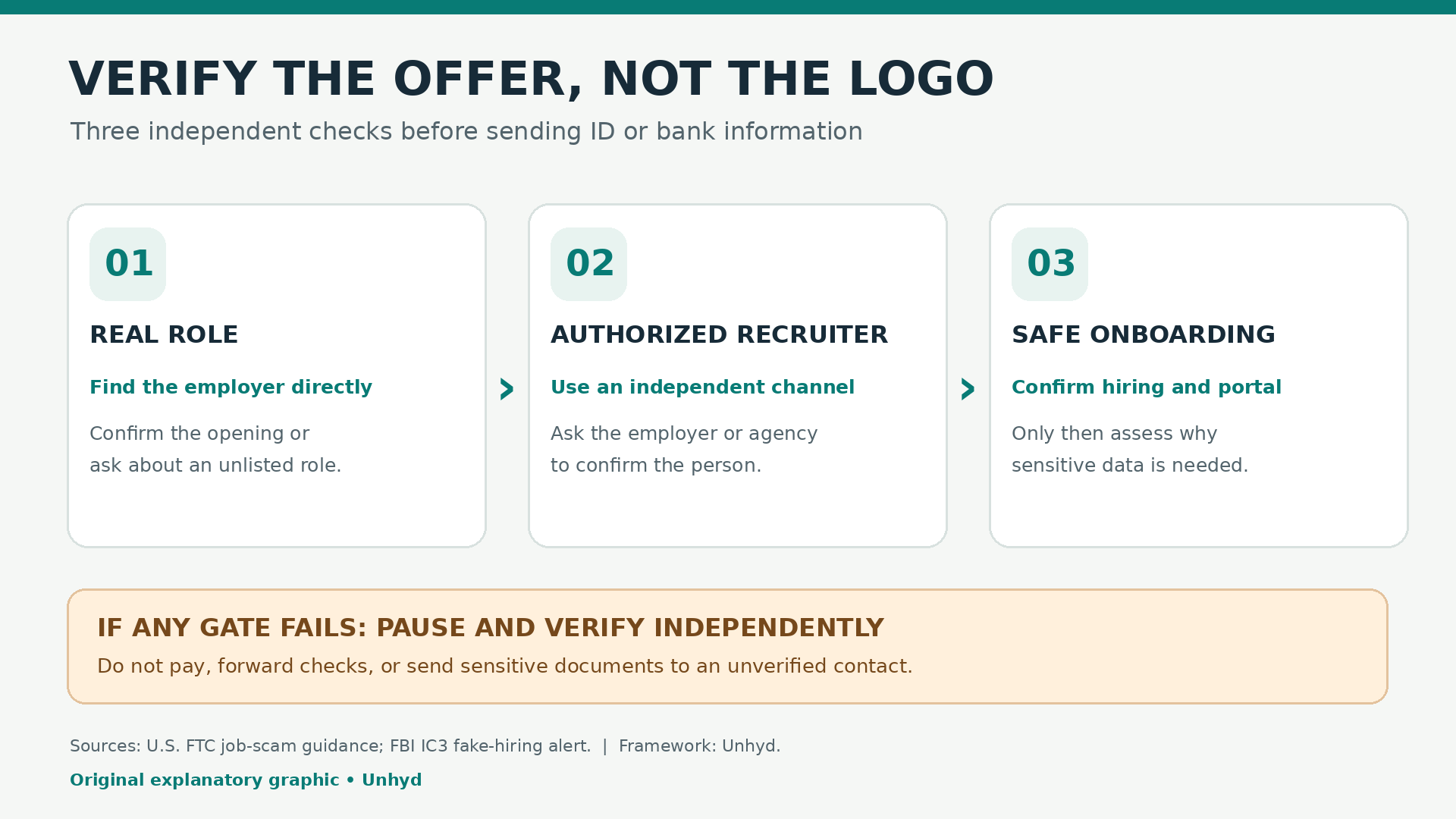
Use the following practical framework as a decision aid. It is Unhyd's synthesis of official consumer-protection guidance, not a government-issued certification or an automated scam detector.
| Gate | Evidence to seek | If it fails |
|---|---|---|
| 1. Real role | Official careers listing or independent employer confirmation | Pause; do not treat the offer as verified |
| 2. Authorized recruiter | Employer or staffing agency confirms the individual and process | Stop sharing documents; verify through a separate channel |
| 3. Safe onboarding | Confirmed hire, legitimate HR portal and appropriate timing for sensitive data | Do not send ID, SSN, bank details or payments |
Passing the first two gates does not mean every future message is safe. A genuine employer may later have a compromised account or a fraudulent lookalike onboarding page may appear. Before entering tax, identity or direct-deposit information, navigate through the employer's verified HR process and check that the request fits the stage of hiring. When in doubt, contact HR independently again.
When is it appropriate to share a Social Security number or bank details?
Legitimate employers may need sensitive information for lawful payroll, tax and employment verification after a person is hired. The timing and channel matter. The FTC says fake recruiters often ask for Social Security numbers, driver's licenses or bank information before they have actually interviewed or hired the applicant. The FBI likewise warns against sending financial details without confirming the employer's identity.
A cautious applicant can share an ordinary resume and relevant work samples through a trusted application channel while withholding information that is unnecessary at that stage. Do not upload a passport, driver's license, Social Security number or banking document simply because an email calls it a 'pre-screening requirement.' Ask what the document is needed for, who will receive it and whether a secure, verified employer system can be used after hiring.
There is no single universal onboarding sequence for every employer, contractor or jurisdiction. Background checks, eligibility verification and regulated roles can have different legitimate requirements. The point is not to refuse all documentation; it is to confirm the actual employer, legal purpose, timing and delivery method before providing it.
Three requests that should stop the process immediately
Paying to obtain the job. A request to buy access to a job, transfer a training fee or pay an invented processing charge is a major fraud signal. The FTC advises job seekers not to pay for the promise of employment. Legitimate employment arrangements can involve ordinary professional expenses in some fields, but an unsolicited recruiter requiring payment as the condition for hiring should not be trusted.
Depositing a check and sending money elsewhere. An apparent equipment allowance can be a fake-check scheme. Funds becoming temporarily available in a bank account do not establish that the check is valid. Do not purchase equipment from the recruiter's specified vendor or forward a portion of the money because the sender says the bank has 'cleared' it.
Moving money, crypto or packages for someone else. An alleged remote job that asks you to use your own accounts to transfer funds, deposit cryptocurrency to unlock tasks or receive and reship goods can create financial and legal risks. Do not test the opportunity by making a small payment or completing one shipment. Preserve the communications and independently report the solicitation.
How to respond when an offer cannot be verified
You do not need to accuse the recruiter or disclose your suspicions. A neutral request is sufficient: 'Before proceeding with onboarding, I need to confirm the role and recruiting contact through the company's published HR channel. Please provide the official requisition number and the name of the department responsible for the hire.' Then verify those details independently. If the sender insists you must act immediately, use only their link or provide sensitive data first, stop.
Save a private record of the job-posting address, sender's full email address, messages, documents requested and any payment instructions. Do not publicly repost someone's personal data while warning others. If a job board hosted the listing, report it through that platform's fraud process. The FBI also recommends reporting impersonation to the real employer.
If you already sent information, act according to what was exposed
If you sent money, contact the bank, card issuer or payment service immediately through its official channel and ask about stopping or reversing the transaction. The FTC's recovery guide distinguishes the steps by payment method and warns that recovery is not guaranteed. Do not pay a stranger who promises to retrieve lost funds.
If you disclosed a Social Security number or identity documents, use the official IdentityTheft.gov process to assess protective steps and obtain a tailored plan. If you gave an account password, change it using the real service, secure any other account where it was reused and enable appropriate multifactor authentication. If you gave banking details, contact the financial institution directly to discuss monitoring and account protection. Different exposures require different responses.
Unhyd's online personal-information guide explains why deleting a public listing is a different problem from identity theft. Its FTC–FBI fraud-data analysis also shows why reported loss totals cannot be treated as a complete census of victims. Neither changes the immediate advice: preserve evidence and act promptly through legitimate institutions.
A verification checklist you can reuse for every offer
- Find the employer's real website independently and identify the role or confirm that it is an unlisted opening.
- Confirm the recruiter and any staffing agency through a separate employer-controlled contact channel.
- Check the complete sender address and any onboarding domain, without treating a familiar logo or HTTPS lock as proof.
- Do not pay for a job, forward a check balance, move money or receive packages for an unverified employer.
- Share sensitive payroll or identity information only after a verified hiring step, through an appropriate official process.
- If anything fails, stop, preserve the evidence and use the FTC or FBI reporting channels as appropriate.
There is no universal visual cue that proves a job offer is real. The strongest protection is procedural: separate the claims in the message from evidence obtained through the actual employer. That approach takes a few extra minutes, but it avoids the more costly mistake of treating a convincing recruitment performance as verified authority.