
AMD and PsiQuantum announced an expanded partnership on November 12, 2026, to design computing infrastructure for future large-scale quantum systems. The AMD PsiQuantum partnership combines conventional processors, graphics chips and programmable hardware with PsiQuantum's photonic approach to quantum computing. The development is a concrete engineering collaboration, not an announcement that a commercially useful quantum computer has begun operating.
AMD also plans an equity investment in PsiQuantum, but the companies did not disclose its amount. That omission matters: the partnership has both a technical and financial component, yet the public terms do not establish the scale of the investment or the cost of building the proposed infrastructure.
What the AMD PsiQuantum partnership includes
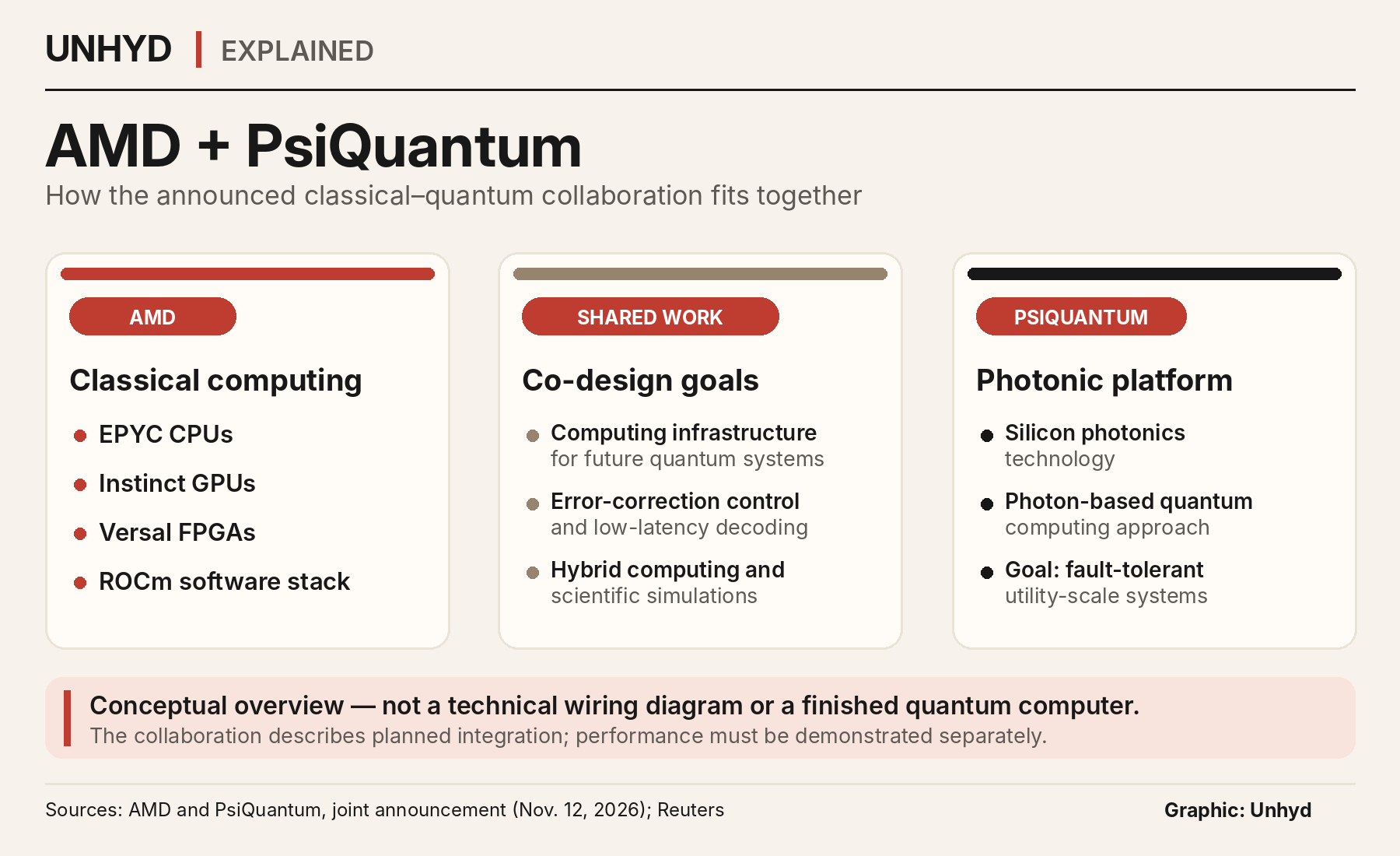
According to the companies' November 12 announcement, the collaboration extends existing work with AMD Versal programmable chips to include AMD Instinct GPUs, EPYC CPUs and the ROCm software ecosystem. PsiQuantum contributes silicon photonics and its planned fault-tolerant quantum computing platform.
The hardware serves different purposes. Classical processors can orchestrate tasks and handle conventional computation; programmable accelerators can be configured for fast, specialized operations; GPUs can support simulation and machine-learning workloads. Photonic quantum systems use light-based components to encode and process quantum information. Integrating these elements is a substantial systems-engineering challenge rather than simply installing a faster processor.
Reuters independently reported the partnership and the planned undisclosed investment. Neither report demonstrates that a full utility-scale, fault-tolerant machine is commercially available.
Why quantum computers still need classical computing
Quantum computing is sometimes presented as a replacement for conventional machines. In practice, large quantum systems are expected to require substantial classical hardware for control, scheduling, error correction and interpretation of results. A useful application may alternate between quantum and classical calculations rather than run entirely on one machine.
One of the hardest problems is error correction. Quantum information is fragile; errors can arise from imperfect operations and environmental effects. A fault-tolerant design aims to detect and manage errors well enough to perform long computations reliably. That requires more than an impressive qubit count: error rates, decoder speed, physical resources and overall system behavior all matter.
The companies say they have optimized a machine-learning decoder called PRISM for low-latency implementation on programmable hardware. That is an engineering direction with a clear purpose: a decoder must keep up with the stream of information needed to detect errors. But the public announcement does not establish an end-to-end independently verified error-correction performance result for an operating utility-scale machine.
What the drug-discovery example shows
AMD and PsiQuantum also describe initial results from simulations of covalent inhibitors, molecules relevant to oncology drug research. This is an example of work being done with AMD computing resources, not proof that a quantum computer has discovered or validated a cancer treatment.
Drug discovery involves multiple stages, from molecular modeling and laboratory validation to animal studies, clinical trials and regulatory review. Better simulation tools may help researchers prioritize questions, but computational results cannot substitute for evidence that a treatment works safely in patients.
PsiQuantum's published applications material outlines its longer-term interest in pharmaceuticals, materials and other scientific problems. The November announcement should be read as progress on the infrastructure and simulation side of that ambition. It does not provide a clinical outcome or a commercial pharmaceutical product attributable to the partnership.
How this differs from other quantum hardware approaches
PsiQuantum is pursuing silicon-photonic technology, which it says can leverage established semiconductor manufacturing methods and optical networking. Other quantum architectures use trapped ions, neutral atoms or superconducting circuits. Each approach faces different scaling, control and error-management constraints.
Unhyd previously covered Mitsubishi Electric's quantum-control research across several hardware approaches. That earlier work provides a useful comparison: progress in the control layer is important even when no finished general-purpose quantum computer is available. AMD's role here is similarly focused on the classical infrastructure needed to make a future quantum system usable.
What would demonstrate meaningful progress?
There are four concrete milestones to watch. The first is independently documented performance of error-correction hardware under representative workloads. The second is a credible accounting of physical resources needed for a useful computation. The third is evidence that hybrid applications outperform a clearly specified classical alternative on a meaningful task. The fourth is a realistic schedule and cost for deployment.
The companies say they plan to discuss the collaboration further at SC26, the supercomputing conference scheduled for November 15–20 in Chicago. That event may provide additional technical details, but its existence should not be mistaken for confirmation that the underlying engineering milestones have been met.
A partnership, not a finished quantum computer
The November 12 announcement matters because quantum computing at scale will depend on more than quantum chips. Control electronics, accelerators, software and systems integration may be decisive. AMD and PsiQuantum have named technologies and an engineering scope, while leaving financial terms and key performance evidence undisclosed.
The appropriate test is not whether the partnership sounds ambitious. It is whether subsequent demonstrations show reliable error correction, reproducible scientific benefit and a feasible path from laboratory components to operating infrastructure. Until then, this is a consequential development in quantum-computing engineering—not a verified breakthrough in commercial quantum computing.