
Alibaba has introduced Qwen4-Max, a new flagship artificial intelligence model, with claims of stronger safeguards against cyber misuse and lower costs for completing AI tasks. The November 16 announcement raises a question that matters more than the model's size: what evidence can developers and businesses examine before relying on those protections?
According to Reuters' November 16 account of Alibaba's announcement, the company says it retained knowledge useful for identifying and repairing software vulnerabilities while excluding material intended to improve offensive hacking capabilities. These are company-reported design choices, not a public demonstration that every dangerous request will be blocked.
What Alibaba says is different about Qwen4-Max
Alibaba describes Qwen4-Max as a 2.4-trillion-parameter model. Parameter count describes the scale of the model architecture; it does not independently establish accuracy, reliability or safety. The company also says its internal testing showed an approximately 60% reduction in average task costs compared with its predecessor. That figure should not be treated as a universal reduction in a customer's API bill. Actual spending depends on workload, token usage, caching, output length and the prices offered to a particular customer.
Alibaba reported a score of 14.7% on a secure-code-generation benchmark, compared with 8% for the previous model. The direction of change is encouraging within the company's reported testing, but neither score supports a claim that the model consistently generates secure code. A benchmark result also does not replace testing against the specific programming languages, dependencies and deployment environments used by a software team.
Why defensive cybersecurity knowledge is a difficult boundary
Cybersecurity work frequently requires the same underlying technical knowledge for legitimate and malicious purposes. Understanding how a vulnerability works can help a developer patch it, while also providing information someone could misuse. A model provider therefore has to distinguish authorized defensive assistance from requests that would materially facilitate attacks. Public descriptions of training-data filtering do not reveal how that boundary performs across prompts, languages and changing attack techniques.
For customers, the practical question is not simply whether the provider says offensive material was excluded. It is whether independent evaluators can test representative misuse scenarios, inspect the limitations of the evaluation, and compare results against a stable baseline. An enterprise using AI to review code should still require ordinary security testing, human approval and controlled deployment processes.
What the safety claims do not yet prove
Alibaba also reported stronger safeguards for chemical, biological, radiological and nuclear threats. Its internal evaluations reportedly found no evidence that the model significantly increased users' ability to carry out dangerous tasks. Reuters explicitly said it had not independently verified those findings. Absence of a detected capability increase under particular tests is narrower than proof that no misuse is possible.
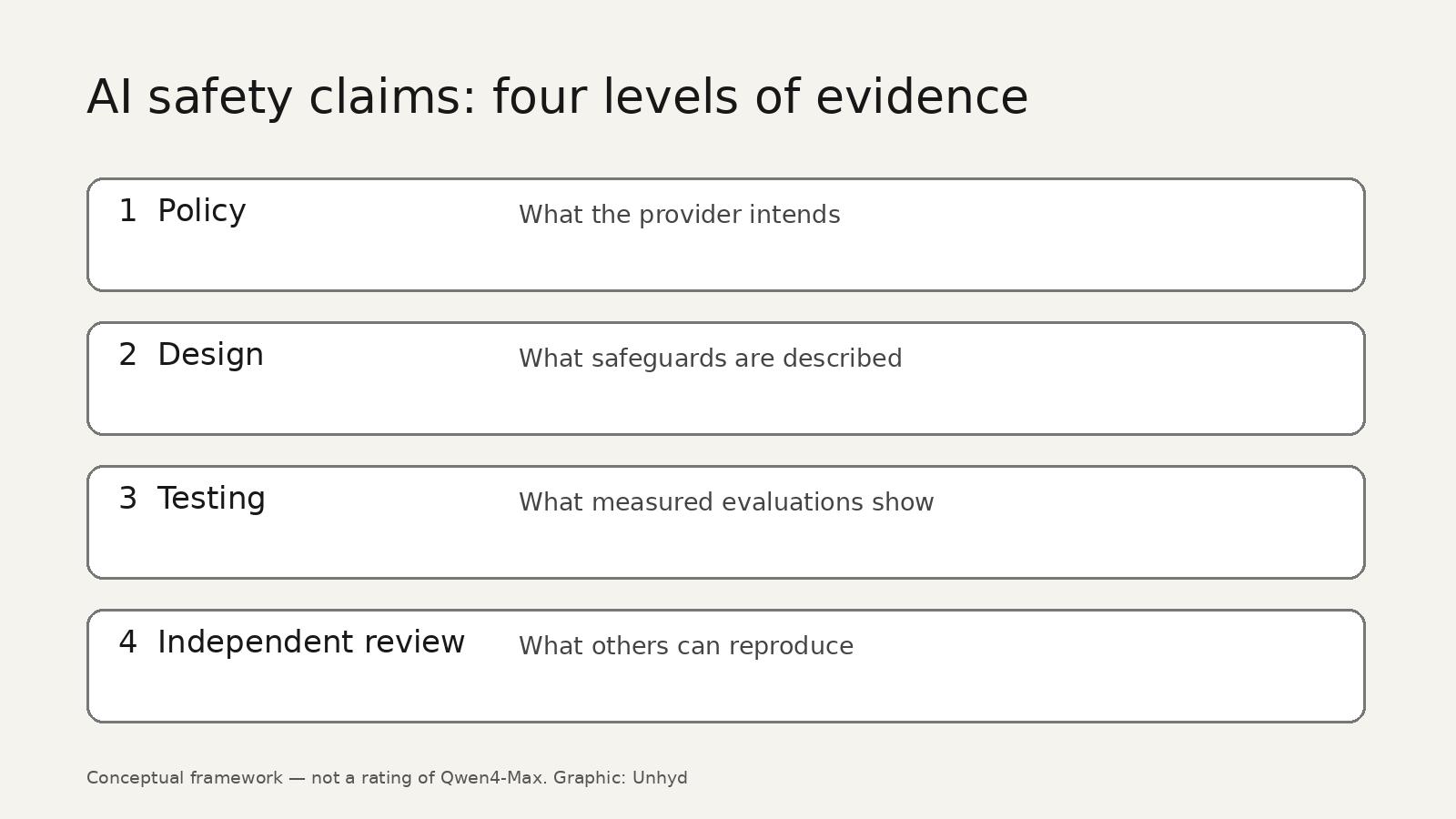
Readers should distinguish four stages: a provider's stated policy, the technical measures it says it implemented, the tests it reports performing, and independent evidence of performance. Each stage answers a different question. A written policy establishes intent; a model-card description documents a design claim; a repeatable evaluation can show performance under defined conditions; and real-world monitoring can identify failures that controlled tests missed.
That distinction also applies to enterprise AI products. In Unhyd's coverage of IBM and Microsoft's enterprise AI agent platform, the central issue was whether governance features could be demonstrated under actual operating conditions. For a general-purpose model, the equivalent question is whether its safeguards hold up when applications connect it to sensitive data, external tools and consequential workflows.
What developers should check before adoption
Organizations evaluating Qwen4-Max should request the model's current documentation, applicable terms, version identifiers, pricing schedule and safety-evaluation methodology. They should distinguish provider-run benchmarks from independent testing, and document any restrictions on sensitive-data processing. A small controlled pilot can then measure the quality of legitimate defensive coding assistance without assuming the model's safety claims cover every deployment.
Cost comparisons deserve the same discipline. A claimed reduction in average task cost is useful only when the tasks, output quality, model settings and total token consumption are comparable. A lower price per token can be offset by a larger number of tokens or additional review steps. Procurement teams should calculate cost per successfully completed, quality-checked task rather than rely on an isolated percentage.
What comes next for the Qwen4 family
Alibaba says it plans to release smaller open-weight models from the Qwen4 family. That is a future plan, not evidence that the flagship Qwen4-Max model itself is open weight or that the promised releases are already available. Developers interested in self-hosting should wait for actual downloadable weights, licenses and model-specific documentation before making infrastructure decisions.
The launch adds to a wider industry movement toward describing safety evaluations more explicitly. Whether that produces meaningful accountability will depend on accessible test methods, independent replication and transparent reporting of failures. For now, the verified news is that Alibaba has announced a new model and published company claims about its safeguards and efficiency. The next useful evidence will be reproducible performance results beyond Alibaba's own tests.