Schneider Electric Q3 2026 results prompted the company to raise its full-year financial targets on October 16 after reporting record quarterly revenue of €11.46 billion, as orders tied to data centers continued to accelerate. The French energy-technology group reported 16.9% organic revenue growth and said demand in its Data Center and Networks end-market increased at a triple-digit rate. That demand figure is not the same as recognized revenue growth, a distinction that matters when assessing how quickly the AI infrastructure boom is turning into sales.
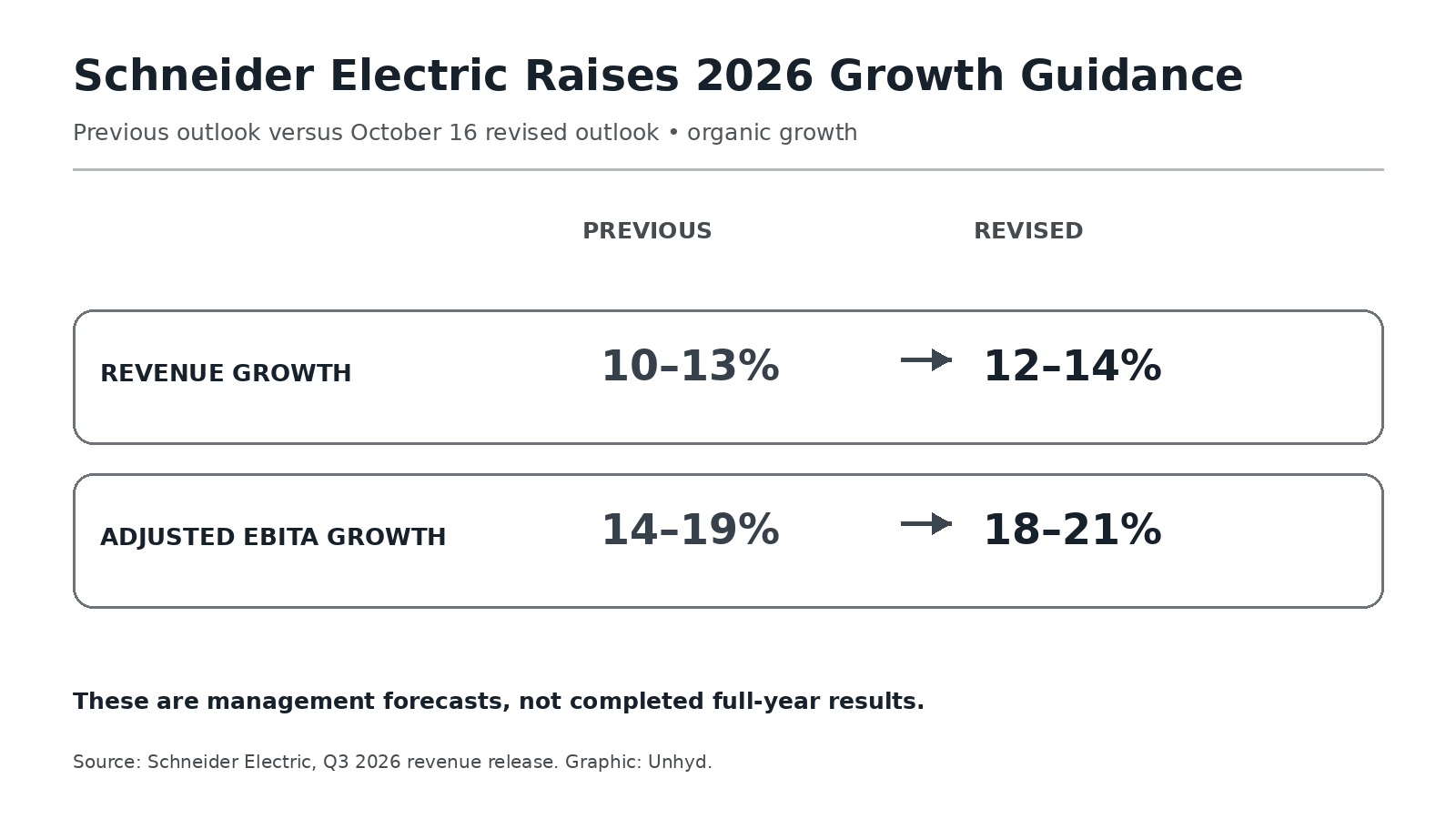
In its October 16 regulated earnings release, Schneider increased its full-year organic revenue-growth outlook to 12%–14%, from 10%–13%, and its adjusted EBITA organic-growth target to 18%–21%, from 14%–19%. These are management forecasts for 2026, not growth rates already achieved for the full year.
What Schneider Electric Q3 2026 results show
The group recorded €11.460 billion in quarterly revenue, up 17.9% on a reported basis and 16.9% organically. Organic growth adjusts for changes in the consolidation perimeter and currency effects, so it should not be presented as an interchangeable measure with reported growth. The company described the quarter as its highest-revenue quarter to date.
Energy Management, which includes electrical distribution and data-center infrastructure, generated €9.615 billion, up 18.8% organically. Industrial Automation contributed €1.845 billion, up 8.1% organically. Together those two divisions account for the reported group total, but their growth rates cannot simply be added to derive the group growth rate. Each division has a different revenue base.
Schneider said demand in Data Center and Networks grew at a triple-digit rate during the quarter. In ordinary terms, that indicates demand more than doubled compared with the relevant prior-year period, but the company did not provide a single exact percentage for the end-market in its headline disclosure. It separately characterized pure data-center sales growth as strong double-digit. An order or demand signal can precede revenue recognition as equipment is manufactured, delivered and installed.
Why the data-center signal is bigger than a server rack
AI computing facilities need far more than processors. They require power distribution, protective equipment, uninterruptible power supplies, cooling systems, controls and services that connect the pieces into an operating facility. Schneider's release identified prefabricated solutions, three-phase UPS equipment and cooling as areas supporting its systems business. Those categories are the physical infrastructure that allows large compute clusters to operate reliably.
That is a useful complement to Unhyd's recent analysis of data-center electricity forecasts. National consumption models estimate how much electricity facilities could use in future years; Schneider's results describe sales and customer demand for equipment being ordered now. Neither metric, on its own, proves when a particular data center will begin operating or how much power it will ultimately draw.
The company's Products business, accounting for 48% of quarterly revenue, grew 17% organically. Systems, 35% of revenue, grew 22%, while Software and Services, 17%, grew 7%. The mix matters because the fastest-growing reported business model was systems, where Schneider highlighted data-center projects. But these categories serve several end-markets, so the 22% figure should not be treated as a pure AI growth rate.
Growth extended beyond North America
North America generated €4.637 billion in third-quarter revenue and grew 19.9% organically. China and East Asia grew 26.1% organically, the strongest regional rate, with €2.153 billion in sales. Europe grew 8.6%, and South Asia and International grew 13.2%. The company said data-center demand contributed in multiple regions, while other industrial and building-related markets also shaped the totals.
These geographic figures underline why a global supplier's quarterly results should not be reduced to spending by U.S. technology companies. Hyperscale demand in North America is an important part of the story, but Schneider also pointed to regional colocation projects and AI infrastructure investment across China and East Asia. At the same time, its other businesses are exposed to conventional industrial automation, commercial buildings and infrastructure investment.
Independent Reuters coverage characterized the raised outlook as the company's second upgrade of 2026 targets, reflecting continued strength in data-center spending. The reporting is consistent with the company's own disclosed results, but the longer-term demand outlook still depends on customer budgets, project schedules and the ability to deliver equipment.
What changed in the 2026 forecast
The guidance revision is the clearest financial consequence of the quarter. Schneider now expects 12%–14% organic revenue growth for 2026, compared with its earlier 10%–13% range. Its adjusted EBITA organic-growth target moved to 18%–21%, compared with 14%–19% previously. EBITA is earnings before interest, taxes and amortization; it is not the same measure as EBITDA, which also excludes depreciation.
The company also expects adjusted EBITA margin to expand by 100–120 basis points organically, implying a margin of roughly 19.7%–19.9% under its stated assumptions. One hundred basis points equals one percentage point. Those margin expectations are forward-looking and subject to changes in the operating environment, currency and the mix of business.
The revised outlook is not a guarantee that demand will translate smoothly into profit. Schneider's release identifies possible Middle East disruption, global supply-chain pressure and inflation among the risks it is monitoring. It expects pricing and productivity to help offset cost pressures, but that is a management expectation rather than a result already recorded for the fourth quarter.
The AI spending test is moving through the supply chain
Unhyd's recent Nvidia earnings analysis focused on accelerated-computing demand. Schneider provides another view of the same broad investment cycle, centered on the electrical and cooling systems needed around the chips. Strong sales at both kinds of supplier can indicate infrastructure spending across multiple layers, but it does not establish that all projects will deliver profitable AI services.
Schneider also noted a definitive agreement to acquire industrial software company PTC, announced earlier in October. That is a separate transaction, subject to closing conditions, and should not be treated as a completed acquisition or as the explanation for the reported third-quarter organic growth. The more immediate operating evidence is the company's disclosed revenue, orders and upgraded guidance.
The next tests will be whether the high data-center demand translates into delivered revenue, whether the revised margin target holds and how much regional demand broadens beyond hyperscalers. For now, Schneider Electric's Q3 2026 results show a real industrial beneficiary of AI infrastructure spending, while leaving the timing and durability of the next phase open.