
The first official trailer for Greta Gerwig's Narnia: The Magician's Nephew arrived on Tuesday, October 13, offering a first extended look at the filmmaker's version of C. S. Lewis's fantasy world. The Narnia: The Magician's Nephew trailer, released by Netflix, follows two children toward the creation of Narnia and places a sweeping theatrical experience at the center of a film financed for a streaming platform.
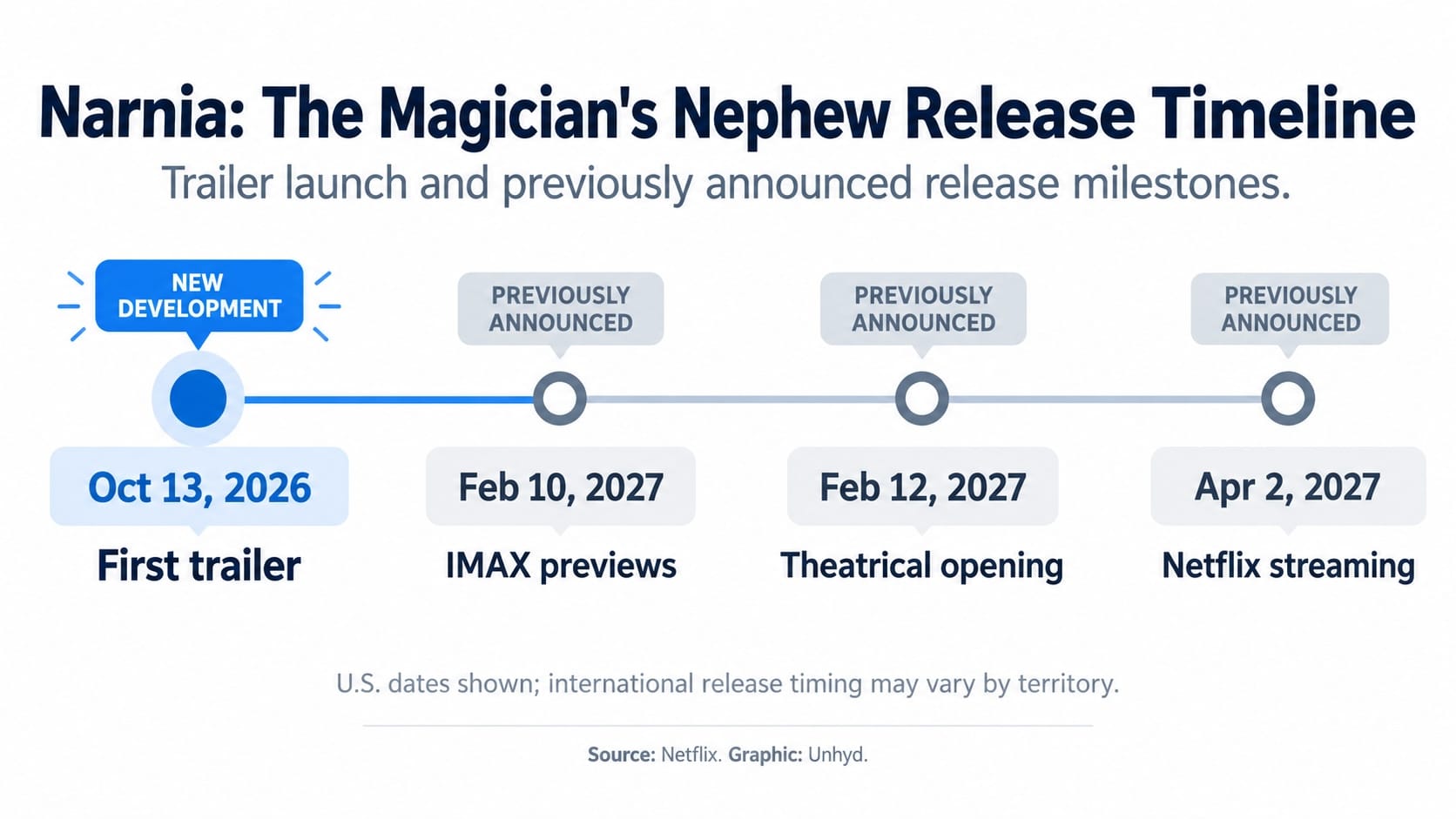
That combination is the real news beyond the images. Netflix plans to open the film widely in theaters on February 12, 2027, after IMAX previews beginning February 10, before bringing it to Netflix on April 2. Those dates were announced months before this week's trailer; they are not newly revealed release dates. What changed on October 13 is that audiences could finally see how Gerwig is presenting the story on screen.
Watch the official trailer for Greta Gerwig's Narnia: The Magician's Nephew, released by Netflix on October 13, 2026. Video: Netflix.
What the Narnia: The Magician's Nephew trailer reveals
Gerwig has chosen a creation story rather than returning directly to the wardrobe that introduced many filmgoers to Narnia. The trailer presents magical rings, a journey between worlds and the suggestion of a universe coming into being. It also introduces the film's central children, Digory Kirke and Polly Plummer, played by David McKenna and Beatrice Campbell.
The footage is accompanied by Led Zeppelin's “Stairway to Heaven,” an unusual choice for a film based on a mid-century fantasy novel. In reporting from the trailer's New York presentation, the Associated Press said Gerwig had approached the musicians to secure permission for the song. That detail helps explain the trailer's tone: it is selling wonder and discovery as much as a familiar franchise name.
The trailer also offers glimpses of Jadis, played by Emma Mackey, and Aslan, voiced by Meryl Streep. But a trailer is a selective marketing document. It cannot tell viewers how much screen time a character receives, whether the finished film will balance spectacle with intimacy, or how faithfully every episode of the novel has been adapted. Those judgments require the film itself.
Why Gerwig starts before The Lion, the Witch and the Wardrobe
The Magician's Nephew was published in 1955, after several other Chronicles of Narnia books, but its events take place earlier in the fictional world's history. It tells an origin story, including how children from London encounter other realms and witness Narnia's beginning. The distinction between publication order and story chronology is worth keeping clear: this is not the first Narnia novel published, but it is a natural starting point for a film series organized around the world's creation.
That choice also gives Gerwig space to establish her own visual language. An adaptation of The Lion, the Witch and the Wardrobe would invite immediate scene-by-scene comparisons with earlier films. An origin story can introduce familiar elements without having to reproduce the same narrative beats first. The trade-off is that a new audience may not yet feel the emotional connection to characters who became icons in the better-known story.
Netflix's official film guide confirms the principal cast, including Daniel Craig, Carey Mulligan and Ciarán Hinds, alongside the younger leads. Craig plays Digory's magician uncle Andrew, whose experiments help set the adventure in motion. The ensemble gives the production star power, but the story's emotional center is expected to rest with its child protagonists.
Netflix's theatrical decision is as revealing as the footage
For years, a Netflix original's defining destination was the streaming service. Narnia is being positioned differently: audiences will have a wide theatrical opportunity before the film becomes available at home. The February 12 cinema opening and April 2 streaming date leave roughly seven weeks between the two milestones. The release plan does not guarantee a box-office hit, but it does signal that Netflix sees value in making this particular film an event outside the app.
That approach fits the scale of the material. Narnia's appeal has always involved entering another world, and the trailer's cosmic imagery is designed to reward a large screen. Yet theatrical distribution carries its own risks: marketing costs, competition for screens, and the need to persuade people who already pay for Netflix to buy tickets instead of waiting. The studio's strategy is a bet on the experience being worth the trip.
Unhyd has previously examined what audiences expect from modern blockbusters, including the pull of spectacle and shared experience. Gerwig's film offers a particularly clear test of that tension. A familiar story can attract attention, but a large format alone cannot supply the emotional stakes that make an audience care.
What is confirmed about the cast and release
Gerwig wrote and directed the adaptation. McKenna and Campbell play Digory and Polly; Mackey plays Jadis; Streep voices Aslan; and Craig portrays Uncle Andrew. Netflix's official materials also list Mulligan, Hinds, Denise Gough, Kobna Holdbrook-Smith and Susan Wokoma among the cast. The trailer premiered online October 13 after a New York IMAX presentation, with independent accounts from the TheWrap and AP confirming the event.
The key dates for U.S. audiences remain February 10 for IMAX previews, February 12 for the wider theatrical opening, and April 2 for Netflix streaming. International theatrical dates may vary by market; viewers should check local listings closer to release. The official Netflix film page is a better reference for the planned streaming destination than a speculative countdown or an unofficial trailer upload.
What the first trailer cannot answer
There are at least three questions worth saving for the completed film. First, can Gerwig make a creation myth feel personal through the experiences of Digory and Polly? Second, can the film introduce Lewis's spiritual and philosophical ideas without assuming that every viewer knows the books? Third, will the unusually prominent theatrical release make the movie feel like an occasion, rather than simply another streaming title with an earlier cinema date?
None of those questions is settled by an impressive two-minute preview. Nor does the trailer establish how future Narnia adaptations will be ordered or released. The film's success will depend on the complete storytelling and the audience response, not on a few images or a recognizable song.
For now, the most useful distinction is between what is newly visible and what was already scheduled. October 13 brought the first official trailer and a public showcase of Gerwig's approach. The theatrical and streaming dates were already on the calendar. Together, they show a filmmaker aiming for a large-scale fantasy experience and a streaming company willing to test how much of that experience audiences still want to share in a cinema.