

The Anthropic public benefit fund is the AI company's latest attempt to put a measurable stake behind its stated social mission. In an October 18 announcement, Anthropic said it intends to commit 5% of its shares to a new wholly owned entity, subject to stockholder approval. It also described a mechanism that could increase the allocation as the company grows. The headline is substantial, but it is not the same as announcing that cash has already been distributed to charities or workers.
The distinction matters because the plan joins three separate questions: who owns the shares, what could trigger additional allocations, and who will ultimately decide how the fund's resources are used. Anthropic has outlined a structure and possible purposes; it has not yet published a complete governance framework or a timetable for grants and direct payments.
The terms behind the headline number
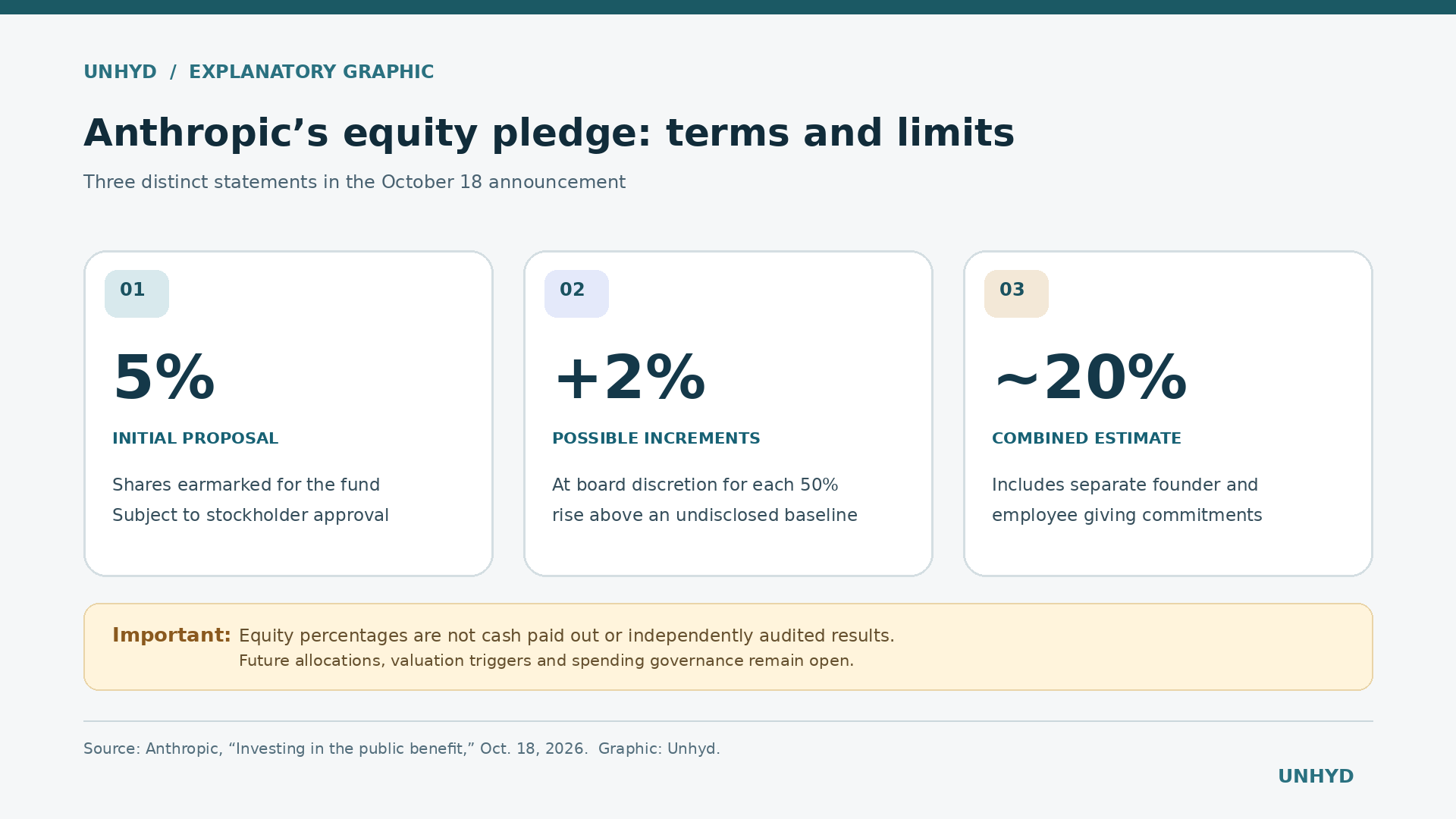
Anthropic says the first proposed transfer would be 5% of its shares, conditional on stockholder approval. An additional 2% could be allocated for every 50% rise in company value above a specified baseline, but those later transfers would be at the board's discretion. The company has not disclosed that baseline, making it impossible to calculate when a further allocation might be considered from the announcement alone.
Those qualifications are not fine print. An equity percentage describes a share of ownership, not an immediately available spending budget. Its financial value would depend on the valuation and on the rights, liquidity and any eventual monetization of the shares. It would be misleading to multiply 5% by a reported valuation and describe the result as money already donated. Independent Reuters reporting also emphasized the approval condition and the discretionary nature of the possible increases.
Why Anthropic chose an LLC rather than a charity
Anthropic says it is establishing the Anthropic Public Benefit Fund as a wholly owned limited liability company rather than a tax-exempt charitable organization. Its stated reason is flexibility: it wants the option to support traditional nonprofits, make direct distributions to particular populations, or pursue other public-benefit activities. These are examples of what the fund might do, not a published list of approved recipients.
The company says none of the equity held by the LLC will be used for lobbying or political giving in the United States or abroad. That is a specific policy commitment. It does not by itself answer who will choose projects, how conflicts of interest will be managed, what reporting the fund will publish, or whether outsiders will be able to evaluate its results. Anthropic says more details about structure and governance will follow in the coming months.
That is a different accountability question from the one addressed by the voluntary White House AI accord, which Unhyd previously examined. The accord concerns oversight of frontier systems. This equity proposal concerns how some of the economic value associated with a model developer might be directed toward wider public purposes. Neither mechanism should be treated as proof of its eventual effectiveness before there is implementation evidence.
How this relates to the existing $200 million research commitment
Anthropic points to its earlier $200 million Economic Futures Research Fund, announced in July, as an example of work aimed at understanding and responding to AI's effects on workers. That program supports external research on workplace changes, retraining, income support and ways to share gains from AI-led growth. It is a separately announced funding commitment, not evidence that the new equity vehicle has already made equivalent grants.
In its October statement, Anthropic says its founders previously pledged to donate 80% of their personal equity holdings and that approximately half of employees participate in a matched equity-giving program. Combining those arrangements with the new proposal, it estimates that roughly 20% of Anthropic shares would be dedicated to public benefit, before any additional valuation-linked transfers.
Readers should not add 5%, 20% and the founders' 80% pledge together. The 20% is Anthropic's combined estimate, while the 80% refers to founders' individual holdings rather than 80% of the entire company. The categories also differ in governance and timing. The company has not supplied a full ownership table in the announcement that would allow an independent reconstruction of the combined figure.
What a meaningful public-benefit test would look like
For workers worried about displacement, the most relevant question is not simply how large an equity pledge sounds. It is whether the structure ultimately funds interventions that can be identified, evaluated and sustained. A useful future report would disclose the amount of equity actually transferred, any proceeds available for deployment, recipient-selection criteria, the amounts committed and paid, and measurable results. Those are proposed evaluation questions, not claims about reporting that already exists.
There is a broader tension here. A fund financed by a successful AI company's equity may grow as the company grows, yet some of the social needs it aims to address could arise during periods of disruption or falling valuations. Equity-linked giving can therefore create a relationship between market performance and available resources. How the fund manages that relationship is not yet explained.
Unhyd has previously covered Anthropic's proposal for independent AI evaluation. The new fund is a different form of public commitment. Both invite the same disciplined question: what can an outsider verify beyond the initial announcement?
What remains unknown
As of October 19, the public announcement does not establish that stockholder approval has been completed, identify a specific baseline for the optional additional 2% allocations, publish the fund's full decision-making rules or name confirmed recipients. Anthropic says it will release more governance information and a public-benefit progress report. Until then, the most accurate description is a conditional equity commitment with a proposed vehicle and possible uses—not a completed distribution of billions of dollars.