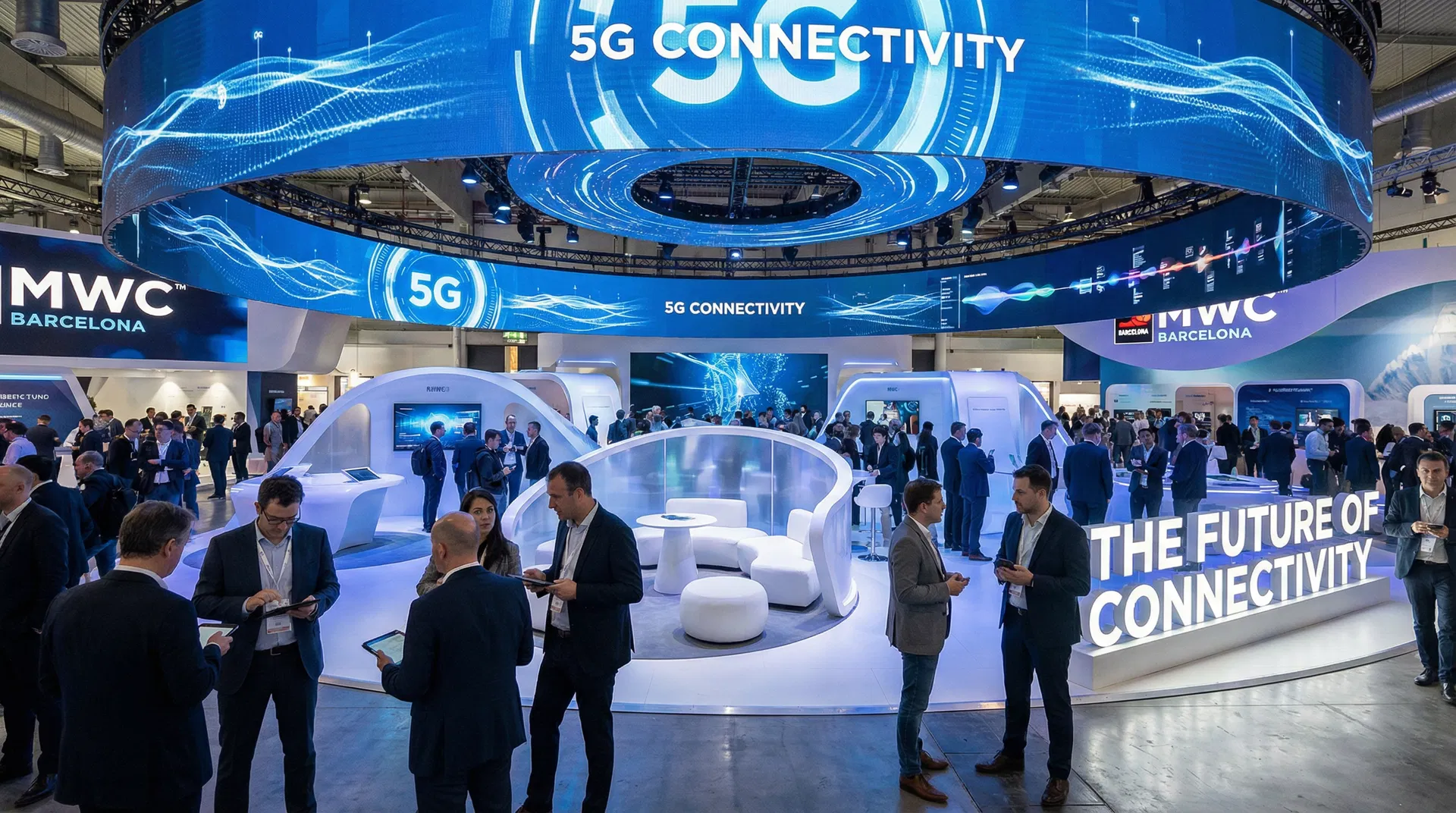
Mobile World Congress 2026 in Barcelona drew over 100,000 attendees from 200 countries, cementing its status as the world's premier connectivity event. This year's congress was defined by the transition from 5G deployment to 5G monetization — and the first serious previews of 6G architecture.
5G Advanced: From Deployment to Revenue
After years of infrastructure investment, carriers are now focused on extracting value from their 5G networks. The emergence of 5G Advanced (5.5G) and its implications for connected cities was a central theme, with operators demonstrating new use cases in manufacturing, healthcare, and public safety.
The 6G Preview
Ericsson, Nokia, and Huawei each presented their 6G research roadmaps, with commercial deployment targeted for 2030. Key 6G capabilities previewed include:
- Terahertz frequency bands enabling 1 Tbps peak speeds
- Sub-millisecond latency for real-time holographic communication
- Integrated sensing and communication — networks that simultaneously transmit data and map their physical environment
- AI-native architecture built from the ground up, rather than AI layered on top of existing infrastructure
Satellite-Terrestrial Integration
The integration of low-earth orbit (LEO) satellite networks with terrestrial 5G was a major announcement theme. SpaceX Starlink, OneWeb, and Amazon's Kuiper all announced new carrier partnerships for seamless handoff between satellite and ground-based connectivity.
Connectivity and the Quantum Future
Several sessions addressed the intersection of quantum networking and 6G — specifically, how quantum computing advances will eventually enable quantum-encrypted communication networks that are theoretically unbreakable.
Key Statistics from MWC 2026
- 100,000+ attendees from 200 countries
- 2,400+ exhibitors across 120,000 square meters of exhibition space
- $1.4 trillion projected global 5G economic value by 2030, per GSMA Mobile Economy report