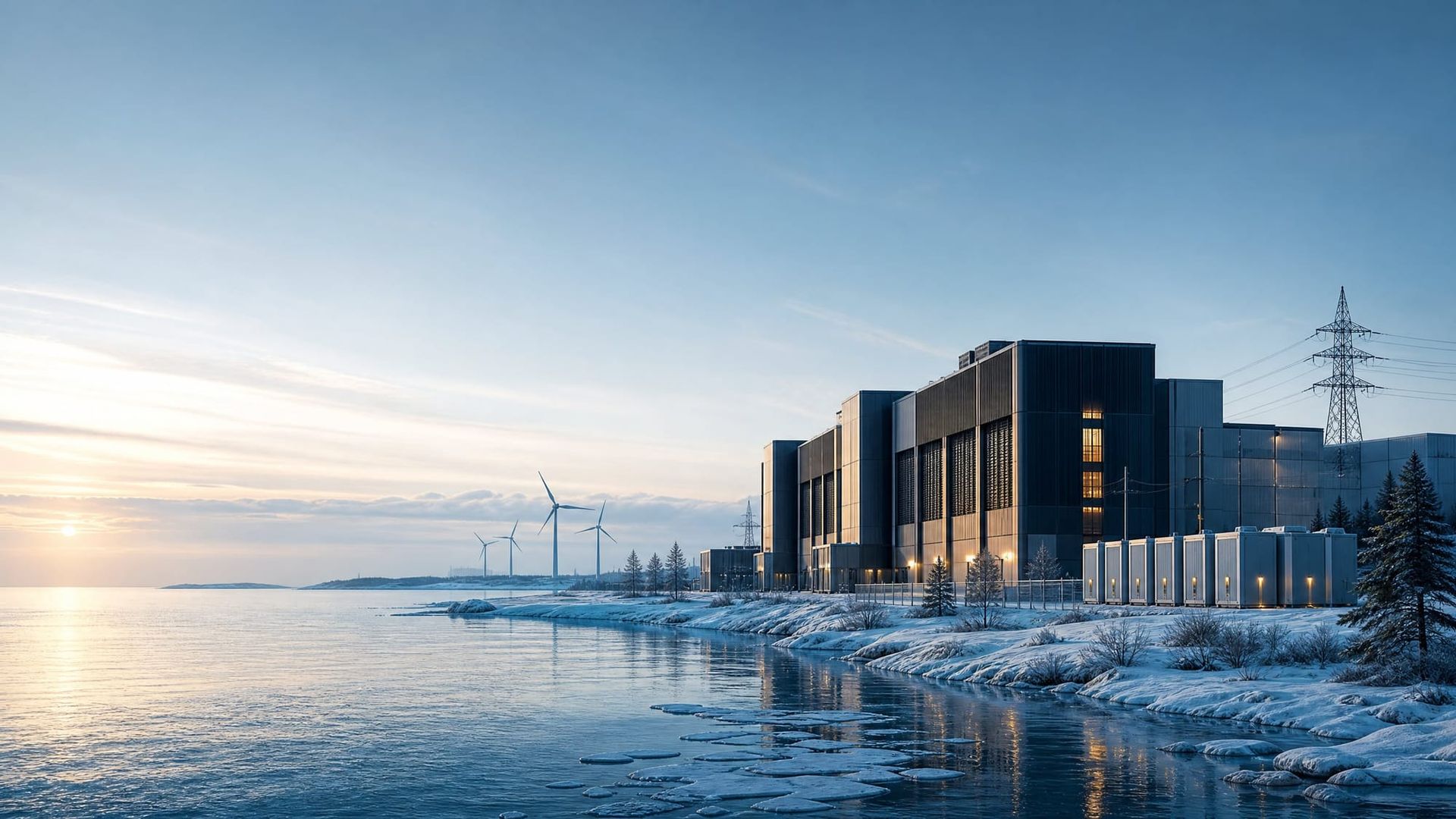
Finland AI infrastructure is the focus of a new €13 billion commitment from Google, which says it will invest in digital infrastructure and supporting partnerships across the country in 2027 and 2028. The announcement is notable not simply for its size—Google calls it its largest single investment in Europe—but for the attempt to pair new compute capacity with power, storage and grid measures.
The commitment covers data centers and related infrastructure and partnerships in Hamina, Kajaani, Muhos and Vaala. It is an investment plan, not a statement that a new fleet of facilities is operating today. That distinction matters. Large AI infrastructure announcements can signal capital and intent, but their practical impact depends on construction, grid connections, equipment delivery and customer availability.
Why Finland AI infrastructure is also an energy story
Google’s plan is built around Finland’s low-carbon electricity system and its northern geography. Alongside the infrastructure investment, Google and Fortum have signed a 22-year power purchase agreement connected to the life extension and upgrade of Fortum’s Loviisa nuclear plant. Fortum says the agreement can cover up to half of the plant’s capacity and is intended to support the lifetime extension and upgrade through 2050.
Google has also announced support for two additional onshore-wind projects, taking its contracted new-to-the-grid wind capacity in Finland to 629 megawatts. A contracted 94-megawatt battery system near Kajaani is expected to enter service in late 2027, according to Google. The company also says it has worked with Fingrid, Business Finland and local municipalities to identify locations where new demand can use existing grid infrastructure near carbon-free generation.
These are separate commitments with separate delivery risks. A power purchase agreement does not build a data center, and a battery contract does not by itself prove that all new load can connect on schedule. But together they make this announcement more specific than a generic promise to add AI capacity. The underlying proposition is that power availability, grid location and flexibility are becoming part of the product strategy for AI infrastructure.
What is new—and what is still a projection
Google says the €13 billion program will support data centers and related infrastructure over two years. It also says the construction phase could contribute an average €3.6 billion a year to Finnish gross domestic product and support more than 37,000 jobs nationwide. Those economic figures are Google’s estimates, not completed outcomes, and should be read as projections tied to execution.
There are tangible starting points. Google’s Muhos location page now says construction of a new data-center campus has begun, while describing the site as still in development. The four-location framing also builds on Google’s established presence in Hamina, where it has operated a data center in a converted paper mill. Still, the September announcement does not provide a full commissioning timetable for every site, a complete facility-by-facility capacity breakdown, or customer service dates.
That leaves several questions open. Will permits and construction stay on schedule? How much additional transmission or local infrastructure will be needed? How will the power contracts and demand-response ideas work in practice during periods of stress? And how quickly will the planned capacity turn into usable cloud and AI services for European customers?
Why the plan matters beyond Finland
Recent Unhyd coverage has examined AI infrastructure at two different scales: PwC’s long-range global investment outlook and a proposed Saudi data-center partnership. Google’s Finland announcement offers a more immediate case study in the same shift. The competition is no longer only about models, chips and capital. It is increasingly about whether a place can align generation, grid capacity, storage, permitting and local acceptance with the demand for compute.
Finland’s appeal is not an automatic solution to those constraints. The key claims in the announcement—including jobs, GDP contribution and energy affordability—remain forward-looking. Yet Google’s decision to attach nuclear life extension, wind procurement, storage and siting to one investment program shows where the AI buildout is heading. The next evidence to watch is not another headline figure. It is the progress of the campuses, grid connections, power projects and service availability that will determine whether this becomes a durable regional AI hub.